If you want to take your photography skills to the next level in 2026, you’ll need the right lenses. I recommend starting with versatile options like the 18-55mm kit lens, which covers wide-angle to standard shots. A macro lens like the 60mm F2.8 is great for close-up detail. Don’t forget to contemplate prime and zoom lenses that suit your style. Keep exploring—there’s more to discover that can help you capture stunning images.
Key Takeaways
- Choose versatile zoom lenses like 18-55mm for beginners, offering flexibility for various shooting scenarios.
- Prioritize lenses with wide apertures (f/2.8 or lower) for better low-light performance and creative background blur.
- Ensure lens compatibility with your camera mount (EF, EF-S, RF, E-mount) to guarantee proper fit and functionality.
- Opt for affordable prime lenses to improve sharpness and low-light shooting without overspending.
- Consider lenses with optical stabilization and fast autofocus to enhance image quality and ease of use.
| Canon EOS Rebel T7 DSLR Camera with 18-55mm Lens |  | Best DSLR for Beginners | Sensor Type: 24.1MP CMOS APS-C | Autofocus System: 9-Point AF, AI Servo AF | Video Recording: Full HD 1080p | VIEW LATEST PRICE | See Our Full Breakdown |
| Canon Rebel T7 DSLR Camera Kit with 2 Lenses | 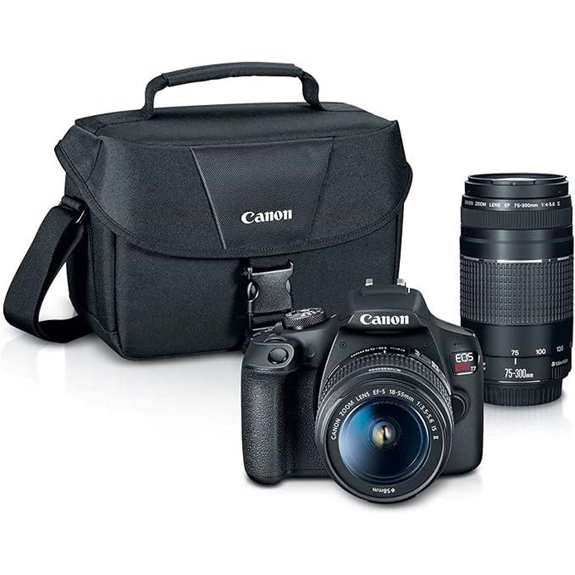 | Versatile Starter Kit | Sensor Type: 24.1MP CMOS APS-C | Autofocus System: 9-Point AF, AI Servo AF | Video Recording: FHD 1080p | VIEW LATEST PRICE | See Our Full Breakdown |
| Canon EOS R100 Mirrorless Camera Kit |  | Compact Mirrorless Choice | Sensor Type: 24.1MP CMOS APS-C | Autofocus System: Dual Pixel CMOS AF, 143 zones, face/eye detection | Video Recording: 4K at 24 fps, HD at 60 fps, 120 fps | VIEW LATEST PRICE | See Our Full Breakdown |
| 7artisans 60mm F2.8 Macro Lens for Sony E Mount |  | Macro Specialist | Sensor Type: 11 elements in 8 groups (no sensor specified, but optical design for macro) | Autofocus System: Manual focus only (no autofocus) | Video Recording: Not specified (macro lens) | VIEW LATEST PRICE | See Our Full Breakdown |
| Canon EOS Rebel T7 DSLR Camera Bundle |  | All-in-One Bundle | Sensor Type: 24.1MP APS-C CMOS | Autofocus System: 9-point AF with center cross-type | Video Recording: 1080p at 30 fps | VIEW LATEST PRICE | See Our Full Breakdown |
| Canon EOS 2000D Rebel T7 DSLR Camera Bundle |  | Beginner DSLR Bundle | Sensor Type: 24.1MP APS-C CMOS | Autofocus System: 9-point AF, center cross-type | Video Recording: 1080p at 30 fps | VIEW LATEST PRICE | See Our Full Breakdown |
| Canon EOS 4000D DSLR Camera Bundle (Renewed) |  | Budget-Friendly Option | Sensor Type: 18.0MP APS-C CMOS | Autofocus System: 9-point AF | Video Recording: 1080p at 29.97 fps | VIEW LATEST PRICE | See Our Full Breakdown |

More Details on Our Top Picks
-

Canon EOS Rebel T7 DSLR Camera|2 Lens Kit with EF18-55mm + EF 75-300mm Lens, Black
Improved Dual Pixel CMOS AF and eye detection AF 24.1 Megapixel CMOS (APS-C) sensor with is 100–6400 (H:...
As an affiliate, we earn on qualifying purchases.
Canon EOS Rebel T7 DSLR Camera with 18-55mm Lens
If you’re just starting out in photography, the Canon EOS Rebel T7 DSLR with an 18-55mm lens is an excellent choice for beginners. It features a 24.1-megapixel APS-C sensor that delivers sharp, detailed images, perfect for learning the basics. The 9-point autofocus system and AI Servo AF help you capture moving subjects with ease. Its optical viewfinder provides about 95% coverage, giving you a clear framing experience. Plus, built-in Wi-Fi and NFC make sharing photos simple. With a versatile ISO range up to 6400, you can shoot in various lighting conditions. Overall, it’s a reliable, user-friendly camera to kickstart your photography journey.
- Sensor Type:24.1MP CMOS APS-C
- Autofocus System:9-Point AF, AI Servo AF
- Video Recording:Full HD 1080p
- Connectivity:Built-in Wi-Fi & NFC
- Image Stabilization:Not specified
- Compatibility:Compatible with Canon EF & EF-S lenses
- Additional Feature:Built-in Wi-Fi and NFC
- Additional Feature:9-Point AF system
- Additional Feature:Full HD video recording
-

Canon EOS R100 Mirrorless Camera RF-S18-45mm F4.5-6.3 is STM Lens Kit, 24.1 Megapixel CMOS (APS-C) Sensor, 4K Video, RF Mount, Black
Stellar Image Quality: Canon EOS R100 4K digital camera with 24.1 megapixel CMOS (APS-C) sensor for superb image...
As an affiliate, we earn on qualifying purchases.
Canon Rebel T7 DSLR Camera Kit with 2 Lenses
The Canon Rebel T7 DSLR Camera Kit with 2 Lenses is an excellent choice for beginners enthusiastic to explore both wide-angle and telephoto photography. It features a 24.1 MP CMOS sensor and improved Dual Pixel CMOS AF for sharp images and smooth focus. The kit includes an EF18-55mm lens perfect for everyday shots and an EF75-300mm lens ideal for capturing distant subjects. With built-in Wi-Fi, NFC, and Full HD video capabilities, this camera offers versatility and connectivity. Its optical viewfinder with 95% coverage and 9-point autofocus system make it easy to frame and focus, helping beginners elevate their photography skills effortlessly.
- Sensor Type:24.1MP CMOS APS-C
- Autofocus System:9-Point AF, AI Servo AF
- Video Recording:FHD 1080p
- Connectivity:Built-in Wi-Fi & NFC
- Image Stabilization:Not specified
- Compatibility:Compatible with Canon EF & EF-S lenses
- Additional Feature:Improved Dual Pixel CMOS AF
- Additional Feature:Eye detection AF
- Additional Feature:Suitable for photography and video
-

7artisans 60mm F2.8 Mark II Macro Manual Focus Camera Lens APS-C Mirrorless Camera Lens for Sony E Mount Cameras Like A7 A7II A7RII A7S A7SII A6300 A6000 A5100 EX-3 NEX-3N NEX-3R NEX-F3K NEX-5 NEX-5N
Internal focusing design: The 60mmF2.8II lens body weighs only 342g and is a small and lightweight design with...
As an affiliate, we earn on qualifying purchases.
Canon EOS R100 Mirrorless Camera Kit
The Canon EOS R100 Mirrorless Camera Kit stands out as an excellent choice for beginners seeking a compact and lightweight camera that doesn’t compromise on image quality. Its small, sleek design makes it easy to carry around, perfect for capturing moments on the go. The 24.1MP APS-C sensor delivers sharp, natural images with beautiful bokeh, while the DIGIC 8 processor ensures smooth performance. It supports 4K video, along with high-speed HD options, making it versatile for both photos and videos. Advanced autofocus with face and eye detection, plus continuous shooting at 6.5 fps, helps beginners elevate their photography effortlessly.
- Sensor Type:24.1MP CMOS APS-C
- Autofocus System:Dual Pixel CMOS AF, 143 zones, face/eye detection
- Video Recording:4K at 24 fps, HD at 60 fps, 120 fps
- Connectivity:Wi-Fi & NFC
- Image Stabilization:Optical IS (image stabilization)
- Compatibility:RF-S lens (for EOS R series)
- Additional Feature:Compact, lightweight design
- Additional Feature:4K video recording support
- Additional Feature:Continuous shooting up to 6.5 fps
7artisans 60mm F2.8 Macro Lens for Sony E Mount
For beginners looking to explore macro photography without investing in bulky or complex lenses, the 7artisans 60mm F2.8 Macro Lens for Sony E-mount offers an excellent combination of performance and portability. Weighing just 342g and measuring 80.5mm, it’s lightweight and easy to carry. Its internal focusing mechanism guarantees smooth operation without changing the lens length. With 11 elements in 8 groups, including an ED element, it delivers sharp, detailed images with minimized aberrations. Capable of focusing as close as 0.175m, it’s perfect for capturing flowers, insects, or still life, making it a versatile choice for beginners.
- Sensor Type:11 elements in 8 groups (no sensor specified, but optical design for macro)
- Autofocus System:Manual focus only (no autofocus)
- Video Recording:Not specified (macro lens)
- Connectivity:No connectivity features
- Image Stabilization:Internal focusing (no stabilization)
- Compatibility:Sony E-mount APS-C
- Additional Feature:Internal focusing design
- Additional Feature:Close focusing at 0.175m
- Additional Feature:11 elements in 8 groups
Canon EOS Rebel T7 DSLR Camera Bundle
If you’re just starting out in photography, the Canon EOS Rebel T7 DSLR Camera Bundle offers an excellent entry point with its user-friendly features and versatile kit. It boasts a 24.1MP APS-C sensor and DIGIC 4+ processor, delivering sharp images and smooth Full HD videos. The bundle includes an EF-S 18-55mm f/3.5-5.6 IS II lens, perfect for everyday shooting, and offers built-in Wi-Fi for easy sharing. Its Scene Intelligent Auto mode and creative filters help beginners capture great photos effortlessly. Compact and lightweight, this kit is ideal for learning the fundamentals and exploring your creative potential as you grow in your photography journey.
- Sensor Type:24.1MP APS-C CMOS
- Autofocus System:9-point AF with center cross-type
- Video Recording:1080p at 30 fps
- Connectivity:Wi-Fi & NFC
- Image Stabilization:Not specified
- Compatibility:Canon EF & EF-S lenses
- Additional Feature:Scene Intelligent Auto mode
- Additional Feature:Creative filters and auto modes
- Additional Feature:Compatible with EOS Utility Webcam
Canon EOS 2000D Rebel T7 DSLR Camera Bundle
Beginners seeking a versatile, high-quality camera package will appreciate the Canon EOS 2000D Rebel T7 DSLR Camera Bundle. It features a 24.1MP APS-C sensor, delivering detailed images with a large surface area. The 9-point autofocus and ISO range up to 6400 (expandable to 12800) make low-light shooting easier. The bundle includes a versatile 18-55mm lens, perfect for everyday photography, plus accessories like a memory card, tripod, and lighting. With built-in Wi-Fi and NFC, sharing your shots is seamless. Its user-friendly interface, combined with Full HD video capabilities, makes this bundle ideal for beginners keen to improve their photography skills.
- Sensor Type:24.1MP APS-C CMOS
- Autofocus System:9-point AF, center cross-type
- Video Recording:1080p at 30 fps
- Connectivity:Wi-Fi & NFC
- Image Stabilization:Not specified
- Compatibility:Canon EF & EF-S lenses
- Additional Feature:6.8 cm LCD screen
- Additional Feature:Supports streaming platforms
- Additional Feature:150 JPEG burst shots
Canon EOS 4000D DSLR Camera Bundle (Renewed)
The Canon EOS 4000D DSLR Camera Bundle (Renewed) stands out as an excellent choice for newcomers who want a reliable, feature-packed camera that’s easy to use. It features an 18MP APS-C CMOS sensor and DIGIC 4+ processor, delivering sharp images and vibrant colors. The bundle includes a versatile 18-55mm zoom lens with quick autofocus, perfect for capturing a variety of scenes. Plus, it supports Full HD video and has built-in Wi-Fi for quick sharing. The 34-piece bundle offers everything you need, from a tripod to filters, making it a great starter kit. It’s a user-friendly option that helps beginners learn and grow in photography.
- Sensor Type:18.0MP APS-C CMOS
- Autofocus System:9-point AF
- Video Recording:1080p at 29.97 fps
- Connectivity:Wi-Fi & NFC
- Image Stabilization:Not specified
- Compatibility:Canon EF & EF-S lenses
- Additional Feature:34-piece accessory bundle
- Additional Feature:6-blade rounded diaphragm
- Additional Feature:Guided Live View and Creative Auto modes
Factors to Consider When Choosing Camera Lenses for Beginners
When selecting a lens, I consider my budget and how much I want to spend upfront. I also look at lens types, such as zoom or prime, and how their features fit my photography style. Plus, I pay attention to aperture, autofocus capabilities, and whether the lens is compatible with my camera to guarantee I make a smart choice.
Budget Compatibility Tips
Choosing the right camera lens within your budget is essential to get the best quality without overspending. I recommend setting a clear budget range and focusing on lenses that deliver the best value within that limit. Starting with versatile zoom lenses, like an 18-55mm kit, is a smart choice—they cover multiple focal lengths and are affordable. For beginners, lenses under $200 often provide good quality without breaking the bank. Keep in mind that specialized lenses, such as macro or telephoto, tend to be more expensive and might be better as future upgrades. It’s also wise to research and compare prices across different retailers to find the best deals and discounts. Staying mindful of your budget ensures you get a lens that improves your photos without unnecessary financial strain.
Lens Type Options
Are prime lenses better for beginners? Not necessarily. Prime lenses have a fixed focal length, which means you can’t zoom in or out, but they often deliver sharper images and larger apertures. This makes them great for low-light shots and creating beautiful backgrounds, which beginners find appealing. However, zoom lenses offer versatility, allowing you to frame shots differently without changing lenses—perfect when exploring various photography styles. Kit lenses, usually covering 18-55mm, are practical starting points since they’re versatile and affordable. Specialty lenses like macro or wide-angle are more niche and may require extra learning, but they can open new creative doors. Ultimately, the best choice depends on what you want to shoot and your willingness to learn different lens types.
Aperture Importance
Aperture size plays a key role in how your photos turn out, especially for beginners learning to control exposure and creative effects. A wider aperture (smaller f-number) lets in more light, which is vital for shooting in low-light conditions without using a flash. It also affects depth of field: larger apertures create a blurred background that isolates your subject, while smaller ones keep more of the scene in focus. Choosing lenses with adjustable or variable apertures offers flexibility to adapt to different lighting situations. For consistent results, lenses with a constant wide aperture like f/2.8 are ideal. Understanding how aperture influences exposure and depth helps beginners master their camera settings and achieve professional-looking photos with ease.
Autofocus Features
When selecting a camera lens for beginners, it’s essential to take into account autofocus features that guarantee quick and accurate focusing, especially in dynamic shooting situations. Modern lenses often include 9-point or 45-point AF systems, helping you track subjects more reliably. Technologies like Dual Pixel CMOS AF or phase-detection AF enable fast, precise focus, reducing missed shots. Eye detection AF is especially helpful for portraits, ensuring sharp, natural-looking eyes. Many lenses also offer manual focus modes, giving you creative control when automatic focus isn’t perfect. Keep in mind, autofocus speed and accuracy depend on the lens design, focusing motor type (like STM or USM), and how well it integrates with your camera. Good autofocus features help you capture moments clearly, even in challenging conditions.
Compatibility With Camera
Choosing a camera lens that fits your gear setup guarantees you get the best results. First, check that the lens mount matches your camera model—whether it’s EF, EF-S, RF, or E-mount—to ensure compatibility. Additionally, verify the lens supports your camera’s sensor size, like APS-C or full-frame, to avoid vignetting or reduced image quality. It’s also important to confirm that the lens’s autofocus system works with your camera’s autofocus motor for smooth operation. Don’t forget to review if the lens’s communication protocols, such as electronic contacts, support your camera’s features like auto exposure and stabilization. Always consult manufacturer specs and user manuals to ascertain the lens is designed for your specific camera model and firmware, preventing compatibility issues down the line.
Versatility for Subjects
A versatile lens is essential for beginners because it can handle a variety of subjects and shooting conditions. A lens with a focal length range like 18-55mm is perfect, covering landscapes, portraits, and close-ups. Manual focus is also helpful, giving me precise control over different scenes, especially in macro or artistic shots. A moderate aperture, around f/2.8 to f/4, offers flexibility for controlling depth of field across various styles. Optical features like image stabilization keep images sharp even in challenging conditions. Additionally, compatibility with different camera systems and the ability to adapt to diverse scenarios make a lens more practical for beginners. Overall, choosing a versatile lens helps me explore multiple genres without constantly switching gear.
Frequently Asked Questions
Which Lens Is Best for Low-Light Photography?
If you’re looking for the best lens for low-light photography, I recommend a fast prime lens with a wide aperture, like f/1.8 or wider. These lenses let in more light, helping you capture sharp images in dim settings. I personally love using a 50mm f/1.8 lens because it’s versatile, affordable, and excellent for low-light shots. It truly transforms your night photography and indoor shots with minimal noise.
How Do I Choose Between Prime and Zoom Lenses?
When choosing between prime and zoom lenses, I consider what I want to capture. Prime lenses are great for sharp images and low-light shots because of their wide apertures, perfect for portraits or street photography. Zoom lenses offer versatility, letting me frame different scenes without changing lenses. I think about my style—if I prefer flexibility or specialized shots—then pick the lens that best matches my photography goals.
What Lens Is Ideal for Portrait Photography Beginners?
For portrait photography beginners, I recommend a 50mm prime lens. It offers a natural perspective and beautiful background blur, making your subjects stand out. It’s versatile, easy to use, and affordable, perfect for learning the craft. I love how it helps me focus on composition and lighting, and the compact size makes it convenient for shooting anywhere. It’s a great starting point to elevate your portrait game.
Are Third-Party Lenses Compatible With Canon Cameras?
Absolutely, third-party lenses are like wildcards in the world of photography—they often play nice with Canon cameras. Most are designed with compatibility in mind, so you can mix and match without worry. Just double-check the lens mount and specifications before diving in. Think of it as adding a splash of color to your toolkit—expanding your creative horizon without breaking the bank.
How Much Should I Budget for a Beginner Lens?
You should budget around $100 to $300 for a good beginner lens. I’ve found that lenses in this range offer great quality without breaking the bank. If you’re just starting out, I recommend focusing on versatile options like a 50mm prime or a kit lens. Keep an eye out for sales or used lenses to get even better value. Investing wisely now helps you grow your skills without overspending.
Conclusion
Choosing the right lens can truly transform your photography journey—it’s like opening a secret door to endless creativity! With the perfect lens in your hands, you’ll capture moments so stunning, they’ll leave everyone breathless. Don’t settle for less; your photography dreams deserve the best tools. Immerse yourself, explore, and watch your skills skyrocket. Remember, the right lens isn’t just equipment—it’s your magic wand to capturing the extraordinary!

Susannah expertise lies in researching and compiling evidence-based content on juicing, nutrition, and overall health. She is committed to ensuring that The Juicery World offers accurate, up-to-date, and trustworthy information to empower readers to take control of their health. Susannah’s goal is to inspire individuals to embrace juicing as a way to nourish their bodies and live their best lives.