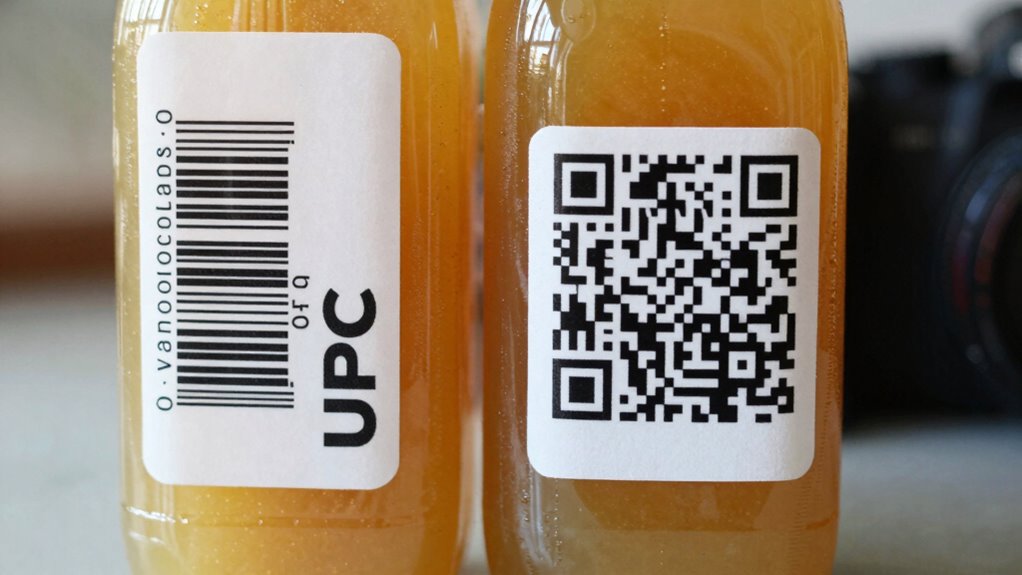

Choosing between UPC and QR codes for your juice bottles depends on your needs. UPCs are great for quick, easy product scans at checkout, helping with inventory and sales. QR codes store more info, like links or nutritional details, and engage consumers through smartphones. Understanding these differences guarantees you pick the right barcode to streamline operations and boost customer interaction. Keep going, and you’ll discover how to effectively use both in your packaging.
Key Takeaways
- UPC codes are traditional barcodes ideal for quick checkout and inventory tracking on juice bottles.
- QR codes store more information, such as links or nutritional details, accessible via smartphones.
- UPCs are scanned with laser or CCD scanners, while QR codes use camera-based devices for decoding.
- Choose UPC for efficient retail product identification; opt for QR codes to enhance marketing and consumer engagement.
- Understanding these differences ensures appropriate barcode use for packaging, sales, and digital interaction.
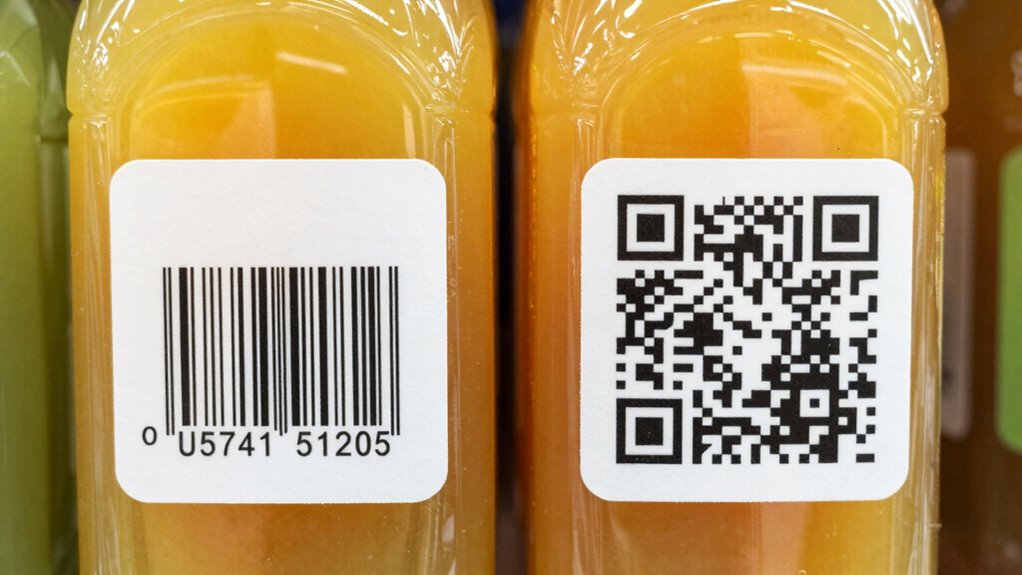
If you’re involved in packaging or retail, understanding barcode basics for juice bottles is essential. Barcodes are the key to efficient inventory management, quick checkout processes, and accurate tracking. When it comes to barcode formats, two of the most common types you’ll encounter are UPC and QR codes. Each serves a different purpose and uses different scanning technology, so knowing their differences helps you choose the right one for your needs.
Understanding barcode types like UPC and QR codes is crucial for efficient juice bottle packaging and retail success.
UPC, or Universal Product Code, is the traditional barcode format seen on most retail products, including juice bottles. It consists of a series of black and white bars with numbers underneath. UPCs are designed for fast, streamlined scanning at checkout counters using laser scanners or CCD scanners, which read the pattern of bars and translate it into a product number. They’re simple, reliable, and ideal for products that stay in fixed locations, making inventory control straightforward. The UPC format’s primary purpose is to identify the product quickly and accurately, ensuring that sales and stock levels update instantly. Its scanning technology is well-established and widely compatible with most retail systems, making it a go-to choice for standard product labeling.
On the other hand, QR codes are a different animal altogether. They’re two-dimensional matrix barcodes that can store much more information than UPCs—such as URLs, promotional details, or nutritional info. You’ll see QR codes on juice bottles when brands want to engage consumers with digital content or provide instant access to their website. QR codes use advanced scanning technology, typically camera-based scanners or smartphones, which capture the entire pattern and decode it. This flexibility allows QR codes to be scanned from various angles and distances, making them versatile for marketing and consumer interaction. Unlike UPCs, which are primarily machine-readable at checkout, QR codes are designed for interactive experiences and can be embedded with a variety of data types, offering more versatility.
Choosing between these barcode formats depends on your goals. If you need quick, efficient product identification at retail checkout, UPC is your best bet. If you want to connect consumers directly with digital content or gather marketing data, QR codes are the way to go. Both formats rely on different scanning technologies, but they’re both essential tools in the modern packaging landscape. Understanding these differences helps streamline your operations, improve customer engagement, and keep your juice bottles well-tracked in the supply chain. Whether you’re labeling for retail or marketing your brand, knowing when and how to use each barcode format is key to success. Moreover, as European cloud servers become more prevalent, utilizing innovative and sustainable cloud solutions can further optimize your data management and security needs in the packaging industry.

NetumScan USB 1D Barcode Scanner, Handheld Wired CCD Barcode Reader
- Scanning Technology: CCD sensor for fast, accurate 1D scans
- Compatibility: Reads codes from paper and screens
- Barcode Types: Supports CODE128, UPC/EAN, add-ons
As an affiliate, we earn on qualifying purchases.
As an affiliate, we earn on qualifying purchases.
Frequently Asked Questions
How Do I Choose Between UPC and QR Codes for My Juice Bottles?
You should choose between UPC and QR codes based on your label placement and design considerations. UPCs are ideal for retail scanning at checkout, so place them prominently on the front for quick scanning. QR codes offer more versatility, allowing consumers to access info via their smartphones; position them in accessible areas without disrupting your design. Consider your target audience and how they’ll interact with your juice bottles to make the best choice.
Are There Cost Differences Between Implementing UPC and QR Codes?
You’ll find that UPC codes generally have lower installation expenses and a straightforward cost comparison, making them more budget-friendly upfront. QR codes might involve slightly higher initial costs due to design and digital integration, but they can offer more versatile marketing options. Overall, consider your needs—if simplicity and low cost are priorities, UPCs are more economical, while QR codes might justify the extra investment for added features.
Can QR Codes Store More Information Than UPC Codes?
Yes, QR codes can store more information than UPC codes due to their larger data capacity and digital storage capabilities. While UPCs are limited to basic product identifiers, QR codes can handle URLs, detailed product info, and multimedia data. This makes QR codes more versatile for marketing and tracking. You’ll find that QR codes are ideal when you want to embed extensive data, thanks to their higher data capacity and efficient digital storage.
Do I Need Special Equipment to Scan QR Codes on Juice Bottles?
Think of scanning QR codes on juice bottles like revealing a secret garden—no special equipment needed. You can use your smartphone’s camera, which is compatible with most QR code scanner apps. When it comes to barcode printing, guarantee the QR code is clear and properly printed for easy scanning. Most modern devices handle QR codes seamlessly, so you don’t need extra tools—just your phone and a quick scan to access information or promotions.
How Do I Ensure My Barcode Is Compliant With Retail Standards?
To guarantee your barcode is compliant with retail standards, you need to follow guidelines for barcode formats like UPC or QR codes. Make sure your barcode is clear, correctly sized, and scannable, meeting retailer specifications. Use high-quality printing and verify the barcode’s readability with scanners. Regularly check for damage or distortion to maintain retail compliance, ensuring your juice bottles pass retail scans smoothly and avoid delays at checkout.
Conclusion
Understanding the difference between UPC and QR codes helps you choose the right barcode for your juice bottles. Did you know that over 70% of consumers scan QR codes to access product info or promotions? By mastering these barcode basics, you can enhance your product’s visibility and customer engagement. So, next time you see a juice bottle, you’ll know whether it’s equipped with a simple UPC or an interactive QR code, making your packaging smarter and more appealing.