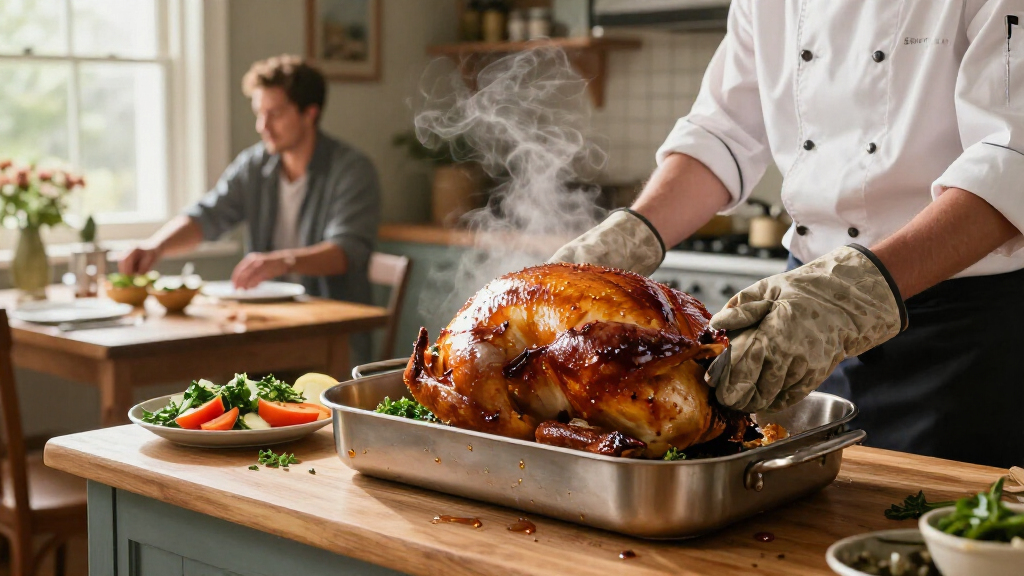
For Thanksgiving, the choice between a stainless steel roasting pan and a nonstick one comes down to what you want the pan to do after the turkey is out of the oven. Stainless steel is the stronger all-around tool for browning drippings, making gravy, and cooking at high heat; nonstick makes the sticky parts of roasting easier to release and wash away. Neither is automatically the better buy: stainless suits cooks who value versatility and durability, while nonstick fits cooks who prize simpler cleanup and do not plan to use the pan for intense stovetop work.

Get kitchen staples and gadgets delivered free with Prime
- Fast, free delivery on millions of items
- Prime Video, Amazon Music and more included
- Member-only deals all year

MICHELANGELO Hybrid Nonstick Roasting Pan with Rack, 17 x 14 Inch
- ✔ Material: Tri-ply stainless steel
- ✔ Coating: PFAS-, PTFE-, and PFOA-free ceramic nonstick
- ✔ Interior dimensions: 16.9 × 14.2 × 3 inches

Caraway Ceramic Nonstick Roasting Pan with Stainless Steel Rack, 16 x 13 in
- ✔ Pan dimensions: 16 × 13 × 3 inches
- ✔ Materials: Ceramic and stainless steel
- ✔ Coating: Nonstick ceramic; described as free of PFOA, PTFE, lead, and cadmium

17 × 13-Inch Nonstick Turkey Roasting Pan with U-Shaped Rack
- ✔ Material: Carbon steel
- ✔ Finish: Nonstick; described as free of PTFE, PFOA, cadmium, and lead
- ✔ Title dimensions: 17 × 13 inches
The difference matters most when you decide how to make gravy, how much scrubbing you are willing to do, and whether this will be a once-a-year turkey pan or a regular piece of cookware. The comparisons below focus on those shared decisions, with an important caveat: construction varies. Check the maker’s temperature limit, handle and rack design, and whether the pan is safe for stovetop use before buying.
At a Glance
| Criteria | Stainless steel roasting pan | Nonstick roasting pan | Winner |
|---|---|---|---|
| Turkey roasting and heat | Usually handles high oven heat well; check the specific pan’s limit | Roasts effectively within the manufacturer’s temperature limit | Depends |
| Browning and gravy | Better for fond and stovetop gravy when the pan is rated for stovetop use | Less suited to scraping fond or making stovetop gravy; some coatings limit heat and utensil choices | A |
| Food release | Food and drippings can stick, especially without enough fat or liquid | Coating helps food release and can reduce sticking | B |
| Cleanup | May need soaking and scrubbing; often dishwasher use depends on the maker | Usually easier to wash; dishwasher safety varies by model | B |
| Durability and care | Often lasts for years with ordinary care; avoid warping from sudden temperature changes | Coating can wear or scratch; follow care and utensil guidance | A |
| Versatility | Strong choice for roasting, pan sauces, and other oven-to-stovetop meals | Convenient for roasting, but less flexible for stovetop cooking | A |
| Value | Often costs more upfront, but can pay off with repeated use | Often a lower-cost, lower-effort choice if easy release matters most | Depends |
MICHELANGELO Hybrid Nonstick Roasting Pan with Rack, 17 x 14 Inch
For a Thanksgiving centerpiece, the MICHELANGELO Hybrid makes the strongest all-around case. Its tri-ply stainless steel body is designed to distribute heat evenly, and the removable rack raises the turkey about an inch above the drippings to encourage airflow beneath the bird. Compared with the carbon steel nonstick pan, it offers a higher stated oven limit—600°F—and works on induction, gas, and electric cooktops. That flexibility can matter when we want to use the roasting pan on the stove as part of a gravy workflow.The textured ceramic nonstick surface is described as free of PFAS, PTFE, and PFOA, and as helping release food and reduce baked-on residue. The rack can be removed when we want the pan for another dish, making this the most adaptable option in the lineup. Its drawback is physical scale: the overall dimensions are 20.3 × 15 × 4.5 inches, and the height reaches 5.5 inches with the rack. We should check both oven clearance and storage space before choosing it. Like the other two pans, it is described for a turkey of about 22 pounds, so the wider listed dimensions do not promise room for a larger bird.This is our top pick when we want one pan to cover roasting and more than one cooktop, and when its generous footprint fits our kitchen. Caraway is a more direct alternative if induction use and a wire rack are the priorities, while the lighter-weighted-in-features carbon steel pan is the simpler option to consider if we chiefly want nonstick roasting.
Pros:
- Tri-ply stainless steel construction is designed for even heat distribution.
- Removable rack raises the roast above drippings and can be taken out for other dishes.
- Works with induction, gas, and electric cooktops.
- Stated oven-safe limit is 600°F.
Cons:
- Overall dimensions and rack height call for generous oven and storage clearance.
- Turkey capacity is stated at about 22 pounds, limiting guidance for larger birds.
- Ceramic nonstick care requirements are not fully detailed in the supplied description.
Best for: Cooks who want a versatile roasting pan for a turkey up to about 22 pounds, with cooktop compatibility and a removable rack.
Not ideal for: Anyone with a tight oven cavity, limited cabinet space, or a turkey larger than the stated approximate capacity.
Bottom line: Choose the MICHELANGELO when its footprint fits and we want the broadest stated oven and cooktop range in this comparison.
“Choose the MICHELANGELO when its footprint fits and we want the broadest stated oven and cooktop range in this comparison.”
Caraway Ceramic Nonstick Roasting Pan with Stainless Steel Rack, 16 x 13 in
The Caraway Ceramic Nonstick Roasting Pan is the most clearly specified match for cooks who want induction compatibility in a roasting pan. Its 16 × 13-inch pan includes a stainless steel wire rack for roasting, basting, and browning. That rack contrasts with the MICHELANGELO’s removable rack, which is described as raising food about an inch above drippings; Caraway’s supplied details do not give a rack height, so we have less information for judging airflow and clearance.Its stated 550°F oven limit is higher than the carbon steel pan’s 450°F, but Caraway also recommends low to medium heat and a small amount of oil or butter. For Thanksgiving, that care guidance matters more than the headline maximum: we should not assume that a higher oven-safe limit means the coating is intended for high-heat stovetop searing. The ceramic finish is described as free of PFOA, PTFE, lead, and cadmium. The description also contains mismatched instructions about a double burner griddle, which makes it harder to tell which usage notes apply specifically to this roasting pan.Compared with the MICHELANGELO, Caraway has a smaller stated pan size and a lower oven limit, but still offers induction compatibility and a stainless rack. Compared with the 17 × 13-inch carbon steel pan, its listed 16 × 13 × 3-inch dimensions are clearer, though both descriptions call for attention to heat guidance. We would choose Caraway when its induction-ready design and rack suit our kitchen, and skip it if high-heat cooking flexibility is central to our plan.
Pros:
- Compatible with induction and other stovetops.
- Includes a stainless steel wire rack for roasting, basting, and browning.
- Stated oven-safe limit is 550°F.
- Ceramic coating is described as free of PFOA, PTFE, lead, and cadmium.
Cons:
- Low-to-medium-heat guidance limits confidence for high-heat stovetop browning.
- The supplied description includes mismatched double-burner-griddle instructions.
- No turkey weight capacity is specified in the supplied details.
Best for: Thanksgiving cooks with induction cooktops who want a ceramic-coated pan and included stainless steel rack.
Not ideal for: Cooks who expect to sear at high heat on the stovetop or want unambiguous care and usage instructions.
Bottom line: Caraway is a sensible induction-focused choice when we follow its moderate-heat guidance and value its stainless steel rack.
“Caraway is a sensible induction-focused choice when we follow its moderate-heat guidance and value its stainless steel rack.”
17 × 13-Inch Nonstick Turkey Roasting Pan with U-Shaped Rack
This carbon steel nonstick pan is the most straightforward option in the lineup: a rectangular roasting pan, U-shaped rack, and angled handles, with a stated capacity for a turkey up to 22 pounds. The rack lifts food above the juices and grease, while the coating is intended to ease food release and cleanup after a long holiday roast. For cooks who want a dedicated turkey pan without the broader cooktop and high-heat positioning of the MICHELANGELO, that simple arrangement may be enough.The tradeoff is that its details leave us with a fit question. The title says 17 × 13 inches, but the listed item dimensions are 15 × 8 × 3 inches. Those measurements differ substantially, so we should confirm the actual pan size with the seller before relying on it for a turkey or checking oven fit. The 450°F maximum is also the lowest stated oven limit here, below Caraway’s 550°F and MICHELANGELO’s 600°F. Its coating is described as free of PTFE, PFOA, cadmium, and lead, but the product information does not list cooktop compatibility.Compared with Caraway’s stainless steel wire rack, this pan’s U-shaped rack is a simpler defined shape, and the angled handles are intended to help maneuver it while preserving cooking area. Compared with the MICHELANGELO, it has a lower temperature ceiling and less stated versatility, but it may appeal to buyers focused on nonstick release and a familiar roasting setup. We rank it third because the dimension discrepancy makes planning a Thanksgiving meal around it less certain.
Pros:
- Nonstick coating is designed for food release and easier cleanup.
- U-shaped rack elevates the roast above drippings.
- Angled handles are designed to aid oven maneuvering.
- Described for turkeys up to 22 pounds.
Cons:
- Title dimensions conflict with listed item dimensions.
- 450°F stated maximum is lower than the other two pans’ limits.
- Cooktop compatibility is not specified.
Best for: Cooks who want a basic nonstick turkey pan with an included U-shaped rack and angled handles.
Not ideal for: Buyers who need confirmed dimensions, a higher oven limit, or explicit cooktop compatibility before purchase.
Bottom line: Consider this pan for a simple nonstick roasting setup only after confirming its actual dimensions and fit.
“Consider this pan for a simple nonstick roasting setup only after confirming its actual dimensions and fit.”
As an Amazon Associate we earn from qualifying purchases.
Key Differences
The clearest practical advantage of stainless steel is what happens after roasting. If the pan is designed for stovetop use, browned bits left behind can become the base for gravy or pan sauce. Stainless also tolerates metal utensils and repeated use better than a coated surface. Its main cost is effort: drippings and baked-on residue can cling, so cleanup may take soaking and scrubbing.
Nonstick trades some of that cooking flexibility for convenience. The coating helps the turkey and drippings release, and washing is generally easier. That can matter after a large meal, when the pan is heavy and the kitchen is busy. The tradeoff is that coatings need gentler care and may limit the pan’s useful life. For a cook who roasts one turkey a year and wants the least fussy wash-up, this can be a sensible compromise; for someone who makes gravy in the roasting pan or cooks with it often, stainless is the better long-term tool.
Value depends on use rather than the holiday price tag alone. A more expensive stainless pan can earn its place through years of roasting and stovetop cooking. Paying extra for it makes little sense if it will sit in storage and you mainly want food to release cleanly. Likewise, a low-cost nonstick pan is not a bargain if its coating wears quickly under frequent use. Compare the construction, size, rack, oven rating, and care instructions, not just the material label.
Detailed Comparison
Turkey roasting and heat (moderate difference)
Both materials can roast a Thanksgiving turkey well when the pan is large enough and rated for the oven temperature in the recipe. Stainless steel generally gives more latitude for high-heat roasting, but the actual limit depends on the handles, coating, and overall construction. Nonstick works within its stated limit; exceeding it can damage the coating. The winner depends on the specific model and recipe, so compare published temperature ratings before buying.
Browning and gravy (Stainless steel roasting pan wins — major)
Stainless steel has the clear advantage if you want to brown vegetables, collect fond, or make gravy in the roasting pan on the stovetop, provided the pan is explicitly stovetop-safe. Its surface supports browning and can be scraped with suitable utensils. Nonstick releases food more readily, but that also makes it harder to build the browned bits cooks often want for pan gravy. Some coated pans should not go on a burner at all. The gap is major for gravy makers and minor for cooks who transfer drippings to a saucepan.
Food release (Nonstick roasting pan wins — moderate)
Nonstick wins for releasing food and residue with less sticking, which can help when lifting delicate roasted vegetables or cleaning around baked-on drippings. Stainless can still perform well with enough fat, liquid, and sensible heat, but it demands more attention to prevent sticking. This is a moderate convenience difference: it rarely decides whether a turkey roasts successfully, but it can change how much work follows.
Cleanup (Nonstick roasting pan wins — moderate)
Nonstick usually takes less scrubbing after roasting, giving it a clear win for cooks who want a simpler cleanup. Stainless steel may need soaking, gentle abrasion, or a cleaner suited to its finish when drippings bake on. Dishwasher instructions vary for both materials, so do not assume either pan is dishwasher-safe. The difference is moderate to major for people who host often or have limited time and help in the kitchen.
Durability and care (Stainless steel roasting pan wins — moderate)
Stainless steel is the better bet for repeated use: it has no nonstick coating to scratch or wear away and usually accepts a wider range of utensils. It can still warp or discolor if mishandled, and quality varies. Nonstick needs more careful handling, including attention to the maker’s heat limit and utensil advice; its coated surface may degrade over time. Stainless wins by a moderate margin for cooks who expect years of frequent service.
Versatility (Stainless steel roasting pan wins — moderate)
A stovetop-safe stainless pan can move from oven roasting to burner cooking for gravy or sauces, making it useful beyond Thanksgiving. Nonstick is best treated as a roasting and baking surface within its care limits; its coating and construction can restrict burner use and utensil choice. Stainless wins clearly for cooks who want one pan to serve several jobs. If the pan is for an annual turkey alone, this difference matters much less.
Value (moderate difference)
There is no universal price winner. Stainless can justify a higher upfront cost when regular use, gravy making, and long service matter. Nonstick may be better value when the priority is easy food release and cleanup at a lower initial cost, particularly for occasional roasting. Compare the pan’s size, rack, construction, and warranty; an inexpensive pan that does not fit the turkey or oven is poor value in either material.
Stainless steel roasting pan: Pros and Cons
Pros:
- Strong choice for browning and gravy when stovetop-safe
- No coating to wear out or scratch
- Works with a wider range of utensils
- Often versatile enough for regular roasting and pan sauces
Cons:
- Food and drippings may stick
- Cleanup can require soaking and scrubbing
- Higher-quality models can cost more upfront
- A heavy pan can be awkward to handle when full
Nonstick roasting pan: Pros and Cons
Pros:
- Food releases readily, which can make serving easier
- Usually simpler to wash after roasting
- Often costs less upfront
- Convenient for occasional turkey and vegetable roasting
Cons:
- Coating can scratch or wear with time
- Heat limits and utensil restrictions vary by model
- Less suited to fond-based gravy and stovetop work
- May have a shorter useful life with frequent use
Who Should Choose What
Choose Stainless steel roasting pan if:
- You make gravy or pan sauce in the roasting pan and the model is rated for stovetop use.
- You cook large roasts throughout the year and want a durable pan with broad utensil compatibility.
- You are willing to soak or scrub the pan in exchange for better browning and versatility.
Choose Nonstick roasting pan if:
- Easy food release and faster cleanup matter more to you than making fond in the pan.
- You roast a turkey occasionally and will stay within the pan’s temperature and care limits.
- You prefer a lower upfront cost and are comfortable replacing the pan if its coating wears.
Skip both if: Skip both if neither style fits your storage, oven size, or budget. A sturdy rimmed sheet pan with a rack may suit smaller birds, while a stockpot or saucepan can handle gravy separately.
Value for Money
Pay more for stainless steel when you will use the pan beyond Thanksgiving: frequent roasts, stovetop gravy, and long-term service can make the extra upfront cost worthwhile. Choose nonstick when its easy release and simpler cleanup solve the main problem and you expect only occasional use; the lower price can be good value if the pan is the right size and you follow its care instructions. For either option, spend on a stable, well-sized pan with sturdy handles and a useful rack before paying extra for features you will rarely use.
Final Verdict
For most cooks who want one roasting pan to keep for years, choose stainless steel. It offers the stronger combination of browning, gravy making, and versatility, with the tradeoff of more cleanup. Choose nonstick if Thanksgiving cleanup is your main concern, you roast occasionally, and gravy can be made in another pan. The deciding factor is whether the roasting pan is part of your cooking workflow after the turkey comes out: if yes, stainless is worth paying more for; if no, nonstick is the more convenient buy. Check the oven rating, dimensions, handles, and stovetop guidance on the exact model before purchasing.
Frequently Asked Questions
Which roasting pan is better for Thanksgiving gravy?
Stainless steel is usually better for gravy made in the roasting pan because it can build browned bits and, when rated for stovetop use, move from oven to burner. A nonstick pan releases residue more readily and may not be suitable for burner cooking. You can still make excellent gravy with either by pouring the drippings into a separate saucepan.
Does a nonstick roasting pan make the turkey cook better?
Nonstick helps food release and can simplify washing, but it does not by itself guarantee a juicier or more evenly cooked turkey. Pan size, oven temperature, the bird’s placement, and checking doneness matter more. Follow the pan maker’s heat limit and the recipe’s temperature guidance.
Is stainless steel worth the higher price?
It can be, if you roast often, make gravy in the pan, or want a surface that will not lose a nonstick coating. For a once-a-year turkey where easy cleanup is the priority, paying more for stainless may not deliver enough benefit.
Can I put a nonstick roasting pan under the broiler?
Only if the maker explicitly says that the specific pan and its handles are broiler-safe. Nonstick temperature limits differ, and broiler heat can exceed them. Check the product instructions rather than relying on the material name.