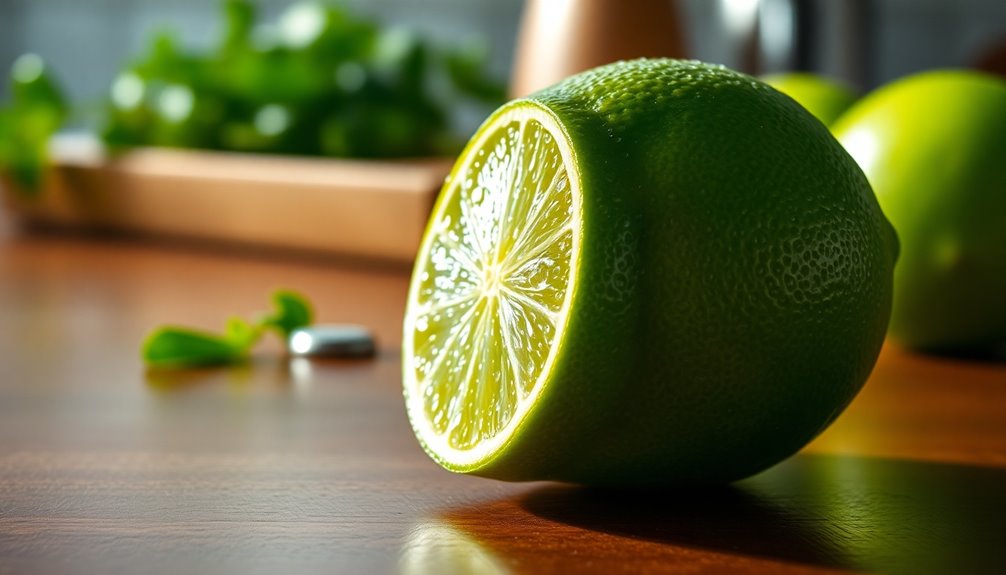

On average, a medium lime gives you about 30 milliliters (2 tablespoons) of juice. If you've got small limes, expect around 15 milliliters (1 tablespoon), while large limes can yield up to 45 milliliters (3 tablespoons). The juice yield varies based on the lime's size and ripeness, so keep that in mind when deciding how many to buy. There's more to know about choosing the right limes and maximizing your juice extraction.

Get kitchen staples and gadgets delivered free with Prime
- Fast, free delivery on millions of items
- Prime Video, Amazon Music and more included
- Member-only deals all year
Key Takeaways
- A medium lime yields about 30 milliliters (2 tablespoons) of juice.
- Small limes produce approximately 15 milliliters (1 tablespoon) of juice.
- Large limes can generate as much as 45 milliliters (3 tablespoons) of juice.
- Juice yield varies depending on the lime's size and ripeness.
- A perfectly ripe lime typically provides more juice than an underripe one.
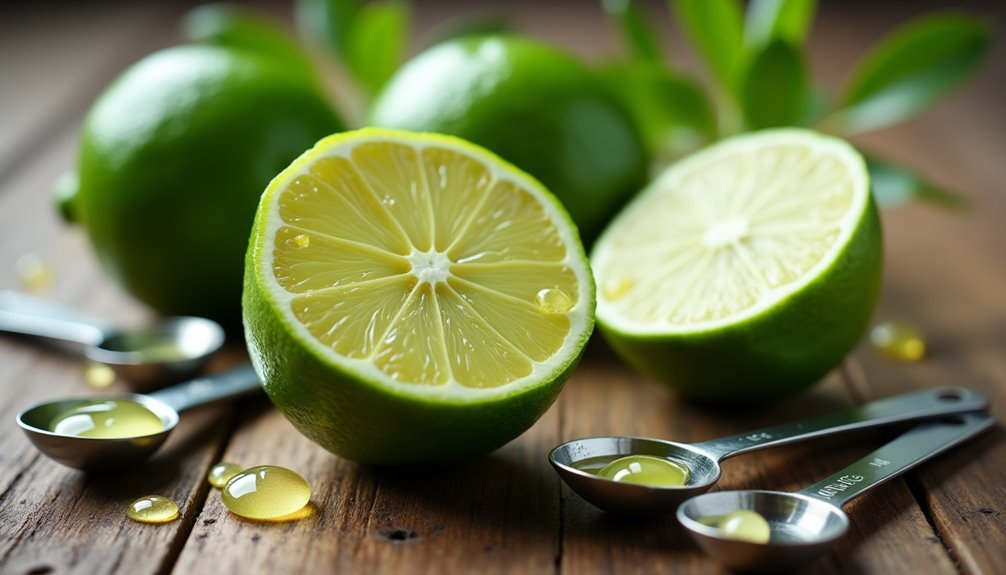
When you're squeezing a lime for your favorite recipe, you might wonder just how much juice you can expect. Knowing the average yield from different lime sizes can help you measure accurately, ensuring your dish turns out as delicious as you envisioned.
Generally, a medium lime yields about 30 milliliters, or 2 tablespoons, of fresh juice. This is a handy figure to keep in mind, especially when you're measuring out ingredients for your culinary creations.
If you're preparing a recipe that requires a larger quantity of lime juice, understanding how many limes to use is crucial. For instance, if you need about 240 milliliters, or 1 cup, of lime juice, you'll typically need around 8 medium limes. This conversion makes it easier to plan your shopping and avoid the frustration of running short on juice when you're in the middle of cooking.
You might encounter different sizes of limes at the grocery store: small, medium, and large. A small lime will yield approximately 15 milliliters, or 1 tablespoon, of juice. Meanwhile, a large lime can produce as much as 45 milliliters, or 3 tablespoons. Knowing these yields allows you to adjust your measurements based on the limes you have on hand.
If you're using a large lime, you could potentially get the juice from just one lime instead of two medium ones, making your preparation quicker and simpler.
When you're measuring lime juice for recipes, consistency is key. The average yield per lime tends to remain stable, with the primary variations arising from the lime's size and ripeness. A perfectly ripe lime will generally provide more juice than an underripe one, so make sure to choose limes that feel heavy for their size and have a slightly glossy skin. This helps ensure you're getting the most juice possible.
For convenience, remember that one medium lime usually provides about 30 milliliters of juice. This makes it a breeze to calculate how many limes you'll need for your recipes. If you find yourself needing a specific amount of juice, like 120 milliliters, just remember that you'd need roughly 4 medium limes.
Frequently Asked Questions
How Much Juice Is in 1 Lime?
When you squeeze one medium lime, you can expect to get about 30 milliliters of juice, which is roughly 2 tablespoons. This amount can vary slightly depending on the juiciness of the lime and its ripeness. If you’re wondering how much juice in half a lime, you can typically expect to get around 15 milliliters, or about 1 tablespoon. This measurement can be helpful for recipes that call for smaller quantities of lime juice. If you’re planning to prepare a dish that requires more lime juice, it’s good to know that you can usually get enough juice from just one lime. In general, if you’re trying to determine how much juice from 1 lime is needed for your recipe, consider squeezing an extra lime to account for any discrepancies in juiciness. This way, you can ensure that your culinary creation has the perfect balance of flavor.
If you only need a small amount, half a lime will yield around 15 milliliters, or 1/2 ounce.
Always keep in mind that the exact amount can vary depending on the lime's size and ripeness.
How Many Limes for 30ML?
Imagine a refreshing summer drink, bursting with citrus goodness.
To get 30 ml of lime juice, you'll typically need one medium lime. If your limes are smaller, grab two, as they yield about 15 ml each.
For larger limes, which can give you up to 45 ml, you might only need a bit more than half.
Always remember, the size and ripeness of your limes can change how much juice you'll get.
How Many Ml Are in One Lime?
When you squeeze a medium lime, you'll get about 30 milliliters of juice, which is roughly 2 tablespoons.
If you're using smaller limes, you might only get around 15 milliliters, while larger ones can yield up to 45 milliliters.
Knowing the juice yield helps you measure accurately for your recipes, so you won't end up with too little or too much lime juice when cooking or baking.
How Many Limes for 25ML Juice?
Have you ever wondered how many limes you need for just 25 ml of juice?
To get that amount, you'll typically need one medium lime, since it yields about 30 ml.
If you're using smaller limes, you might require about 1.5 limes, as they yield around 15 ml each.
Conclusion
In conclusion, when you squeeze a medium lime, you can expect to extract about 30 to 35 milliliters of juice. This small citrus fruit packs a punch, as it contains more vitamin C per ounce than an orange! So, the next time you're whipping up a refreshing drink or adding a zesty kick to your dish, remember that those little limes hold a treasure trove of flavor and nutrients that can elevate your culinary creations.
Halloween Picks
halloween
As an affiliate, we earn on qualifying purchases.