
TL;DR

Get kitchen staples and gadgets delivered free with Prime
- Fast, free delivery on millions of items
- Prime Video, Amazon Music and more included
- Member-only deals all year
Baking experts Ricky Webster and Stephanie Powell recommend storing bread on the counter in a bread box when it will be eaten soon, and freezing it for longer storage. They advise against routine refrigeration because it can speed staling, while noting that hot or humid conditions may make the fridge useful for preventing mold.
A recent Kitchn report says two baking experts recommend keeping bread in a bread box on the counter for short-term use and freezing it when it needs to last longer. They advise against routine refrigeration because a refrigerator can dry bread and speed staling, although hot or humid conditions may make the fridge a practical exception.
The advice comes from Ricky Webster, a professional baker, pastry instructor and former bakery owner, and Stephanie Powell, a recipe developer for Alpha Baking Co. and S.Rosen’s. Both favor a bread box kept away from direct light and heat. Powell says commercially packaged bread can last until the best-by date in a bread box, while bakery bread is likely to keep for about two to three days.
For crusty loaves and sourdough, Webster prefers a breathable linen bag to help preserve the crust and avoid a spongy texture. He says three days is about the limit before the loaf starts to go stale. Slicing also makes bread go stale more quickly, so Webster recommends keeping a loaf whole and cutting slices as needed.
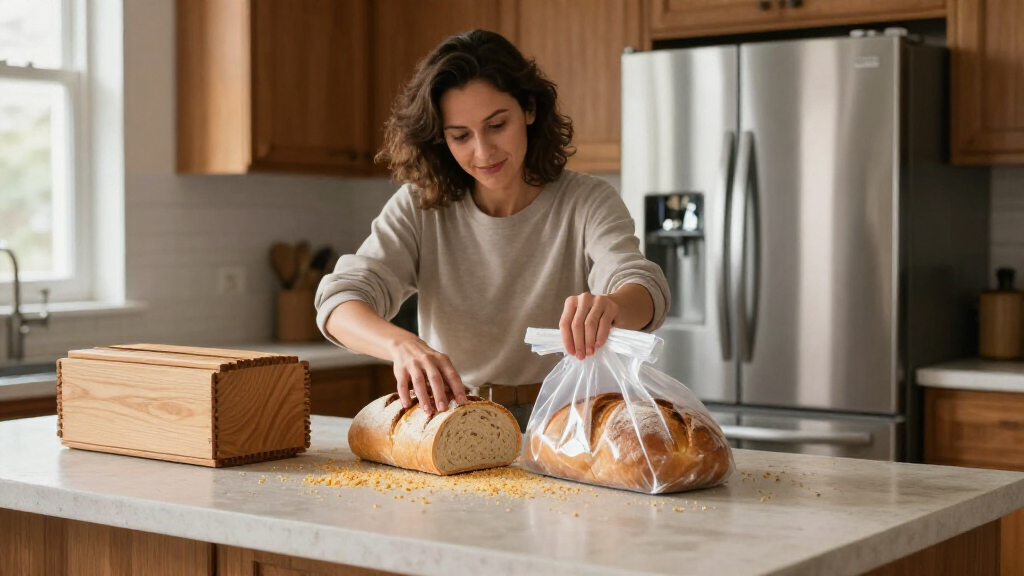
For longer storage, Webster recommends freezing bread as soon as possible, in a tightly sealed freezer-safe bag with as much air removed as possible. He says bread can be kept frozen for two to three months. To revive a frozen loaf or portion, he suggests placing it cut-side down on a sheet pan, where applicable, and baking at 400°F for 12 to 15 minutes, until the crust is crisp and lightly browned. Let it cool before slicing.
Choosing Storage by How Soon You’ll Eat
The choice affects both texture and food waste. A bread box suits loaves likely to be eaten within a few days; freezing offers a way to keep extra bread for later without relying on the refrigerator, which the experts say can accelerate staling. Keeping bread whole until it is needed may also help it stay fresh longer.
The recommendations give shoppers a practical way to handle a loaf that will not be finished quickly: leave out only what you expect to use soon, and freeze the rest. That can be useful for making toast, grilled cheese, croutons or bread pudding later, though the source does not compare specific storage methods in a controlled test.
As an affiliate, we earn on qualifying purchases.
The Experts’ Storage Recommendations
The Kitchn report frames the advice around a common storage question: whether bread belongs on the counter, in the refrigerator or in the freezer. It attributes the recommendations to two baking professionals, rather than presenting them as results from a laboratory study or a formal food-storage trial.
For a particularly hot or humid home, Webster allows for an exception to avoiding the fridge. He advises keeping out only the amount likely to be eaten in one or two days and freezing the remainder. The report also says portions can be divided into bags sized for one to two days of use, with frozen portions moved to the refrigerator when needed.
““This helps ensure that it stays crusty and doesn’t get spongy; however, three days is the max before it starts to go stale, but that’s when the toaster comes in handy.””
— Ricky Webster, as quoted by The Kitchn
When Refrigeration May Help
The report does not provide a controlled comparison of how long different bread types stay fresh under each storage method. The quoted time ranges are expert guidance, not guarantees: results may vary with the loaf, packaging, room conditions and how it has been handled.
Webster identifies extreme heat or humidity as a possible reason to refrigerate bread to limit mold, but the report does not define temperature or humidity thresholds. It also does not say how long bread remains safe to eat in every setting. Bread showing mold should not be treated as salvageable by toasting or baking; discard it rather than relying on reheating.
A Practical Plan for Each Loaf
The guidance points to a simple routine: store the amount you expect to eat within a day or two in a bread box or suitable bag, then freeze the rest promptly in sealed portions. Keep crusty loaves whole when possible, and slice as needed. When reheating a frozen loaf, follow Webster’s 400°F, 12-to-15-minute method, checking for a crisp crust and allowing the bread to cool before cutting.
No further testing or follow-up findings are included in the source report. Readers’ best choice will depend on how quickly they use the bread and whether their home is unusually hot or humid.
Key Questions
Should bread go in the refrigerator?
Usually, the two experts quoted by The Kitchn recommend avoiding the fridge because it can draw moisture from bread and speed staling. Webster says extreme heat or humidity may be an exception if refrigeration helps limit mold.
How long can bread stay in the freezer?
Webster recommends storing bread in a sealed, freezer-safe bag with as much air removed as possible. He says it can be frozen for two to three months.
What is the best way to store bread on the counter?
The experts favor a bread box away from direct heat and light. For crusty bread or sourdough, Webster prefers a breathable linen bag; he says that kind of loaf may start to go stale after about three days.
How do you reheat frozen bread?
Webster suggests placing a frozen loaf or portion cut-side down on a sheet pan when applicable and baking it at 400°F for 12 to 15 minutes, until the crust is crisp and lightly browned. Let it cool before slicing.
Does sliced bread go stale faster?
According to Webster, bread keeps longer as a whole loaf. He recommends slicing only what is needed rather than cutting the entire loaf in advance.
Source: rss
Fall Picks
fall essentials
As an affiliate, we earn on qualifying purchases.