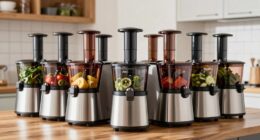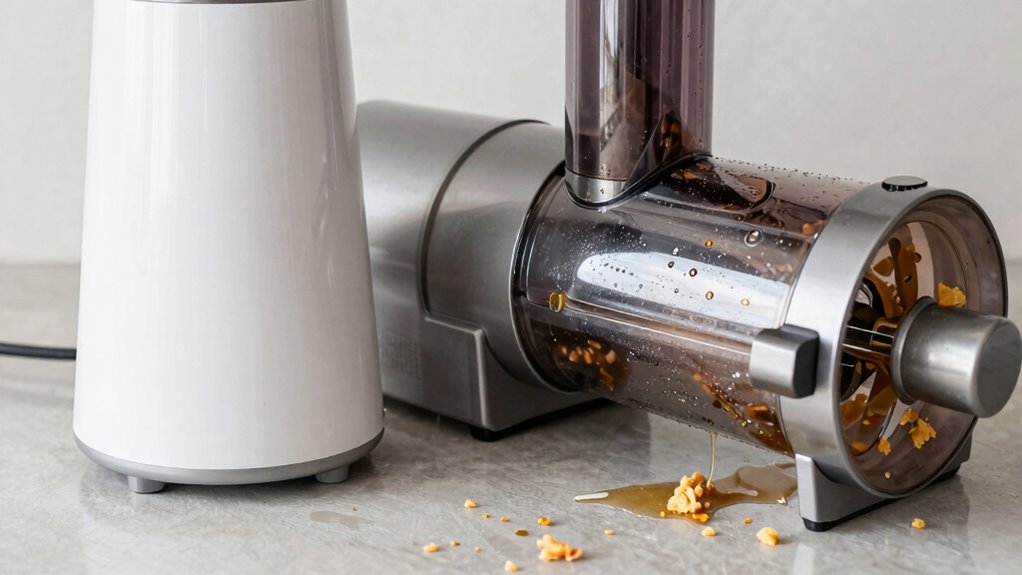

If you pick the wrong type of slow juicer, cleaning can become a frustrating chore. Vertical models are typically easier to clean with fewer parts and quicker disassembly, making cleanup less of a hassle. Horizontal juicers, while often offering higher juice yields, tend to have more components and a more complex setup, leading to longer, messier cleanups. Keep in mind which features matter most to you; exploring this further can help you find a model that’s easier to maintain in the long run.
Key Takeaways
- Vertical juicers typically have fewer parts, making cleaning faster and easier than horizontal models.
- Horizontal juicers often feature more components, requiring more time and effort during disassembly and cleaning.
- Vertical juicers’ compact design reduces surface area and crevices where pulp and residue can accumulate.
- Horizontal models may have complex assemblies, increasing the difficulty of thorough cleaning.
- Choosing a vertical juicer can save time and reduce hassle in regular maintenance, preventing cleaning frustrations.
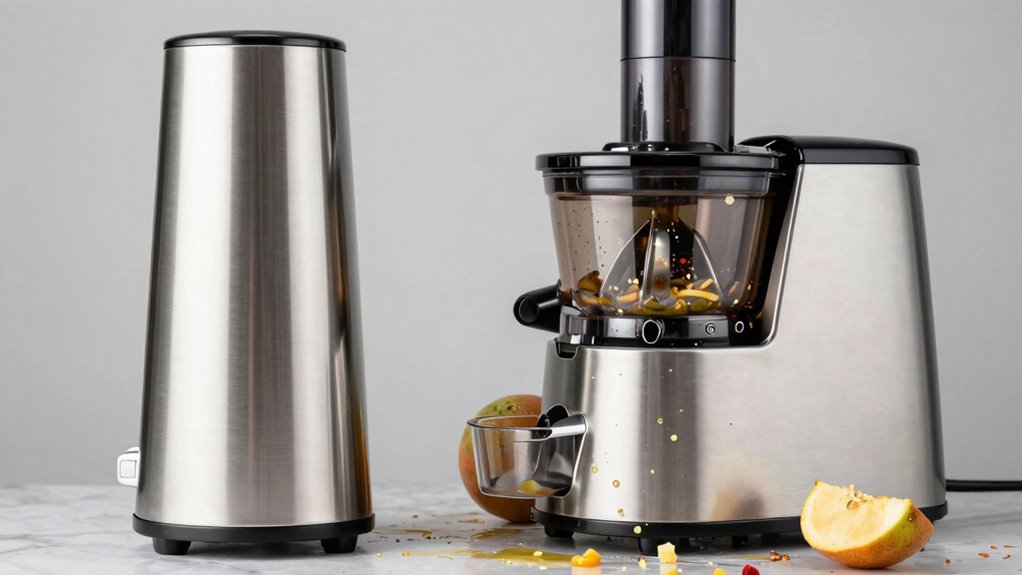
When choosing a slow juicer, understanding the differences between vertical and horizontal models can help you make the best decision for your needs. One of the key factors to contemplate is motor efficiency, which directly impacts how well the juicer operates and how much effort it takes to extract juice. Vertical juicers typically have a motor designed for continuous, efficient operation, often making them better at maintaining consistent motor efficiency over time. This means you’ll get smoother operation and less strain on the motor, especially when juicing large quantities. The motor efficiency also influences juice quality; a more efficient motor can extract more nutrients from your produce, resulting in richer, more flavorful juice with less pulp and foam.
Vertical juicers offer efficient, consistent motor performance for smoother, nutrient-rich juice with less effort.
Vertical juicers are generally designed with a narrow, upright chute. This design often allows for faster juicing because the produce can be fed directly into the auger in a streamlined manner. Since the motor works efficiently with less resistance, you’ll notice faster extraction times, which is particularly helpful when you’re in a hurry. The vertical orientation also makes cleanup easier because many parts are simplified and fewer components need to be disassembled. Plus, the vertical design tends to be more compact, saving space on your countertop, which is a bonus if storage is limited.
Horizontal juicers, on the other hand, often feature a wider feed chute and a different mechanism for extracting juice. These models tend to have a more powerful motor that can handle tougher produce and leafy greens more effectively. The motor efficiency in horizontal models is usually geared toward maximizing juice yield and maintaining high juice quality, especially with fibrous or dense fruits and vegetables. Because of their design, horizontal juicers often require a bit more effort to clean, as they have more parts and a more complex assembly. This can turn into a hassle if you’re looking for a quick and easy cleanup after juicing.
While both types can produce excellent juice, your choice should depend on your priorities. If you want faster operation, easier cleanup, and a compact size, a vertical slow juicer might be your best bet. But if you often juice tougher produce and want maximum juice yield with high-quality results, a horizontal model might serve you better, despite the extra cleaning effort. Ultimately, understanding how motor efficiency and juice quality vary between these two styles helps you find a juicer that aligns with your lifestyle and preferences, ensuring you don’t end up frustrated with the cleaning process or disappointed with your juice.
Additionally, motor efficiency is influenced by the technology used in the juicer, which can differ based on whether it utilizes DLP or LCD technology, affecting overall performance and longevity.
Frequently Asked Questions
Which Juicer Type Is More Durable Long-Term?
You’ll find that horizontal juicers generally offer better durability compared to vertical models. Their durability comparison shows they often have sturdier construction, especially with materials like stainless steel or high-quality plastics, which enhance material longevity. Horizontal juicers are built for long-term use, handling tougher produce without breaking down. If you want a juicer that lasts, opt for one designed with durable materials and solid construction, ensuring it stands the test of time.
Can Vertical or Horizontal Juicers Handle Wheatgrass Better?
Vertical juicers excel at wheatgrass extraction because they typically have narrow, high-speed augers that efficiently crush tough greens. Horizontal juicers, however, often offer better juicer attachment compatibility for wheatgrass, making it easier to process large quantities. If you prioritize wheatgrass, a vertical juicer is generally more effective, but check the attachment options to guarantee it suits your needs, making juicing smoother and quicker.
Are There Differences in Noise Levels Between the Types?
You’ll notice vertical juicers tend to be quieter, offering lower sound levels, making mornings less disruptive. In contrast, horizontal juicers often generate more noise due to their motor design and larger mechanisms. The noise comparison shows vertical models are better if you want a peaceful experience, especially while juicing early or late. So, if quiet operation matters to you, opt for a vertical juicer to enjoy a calmer, less noisy process.
How Do Cleaning Times Compare for Each Juicer Style?
You’ll find cleaning ease varies between vertical and horizontal slow juicers, with vertical models generally being quicker to clean thanks to simpler parts and fewer nooks. Horizontal juicers often require more maintenance frequency because of their complex components and larger cleaning surfaces. If you want to save time, opt for a vertical juicer, as it simplifies cleaning and reduces your overall maintenance effort.
Which Juicer Type Is More Energy-Efficient?
You’ll find that vertical slow juicers are generally more energy-efficient because their motor efficiency optimizes power consumption during operation. They often use less electricity compared to horizontal models, which tend to have higher power consumption due to larger motors needed for their design. By choosing a vertical juicer, you reduce energy use, making it a smarter, more eco-friendly option that saves you money on electricity bills over time.
Conclusion
Choosing the right juicer is like picking a path through a garden—some routes are smoother, others more tangled. If you pick wrong, cleaning becomes a thorny task that dampens your zest for crisp juice. But when you find the perfect fit, it’s like a gentle stream, flowing effortlessly, leaving behind only pure, vibrant goodness. Make your choice wisely, and let your mornings be as invigorating and easy as a gust of fresh air.