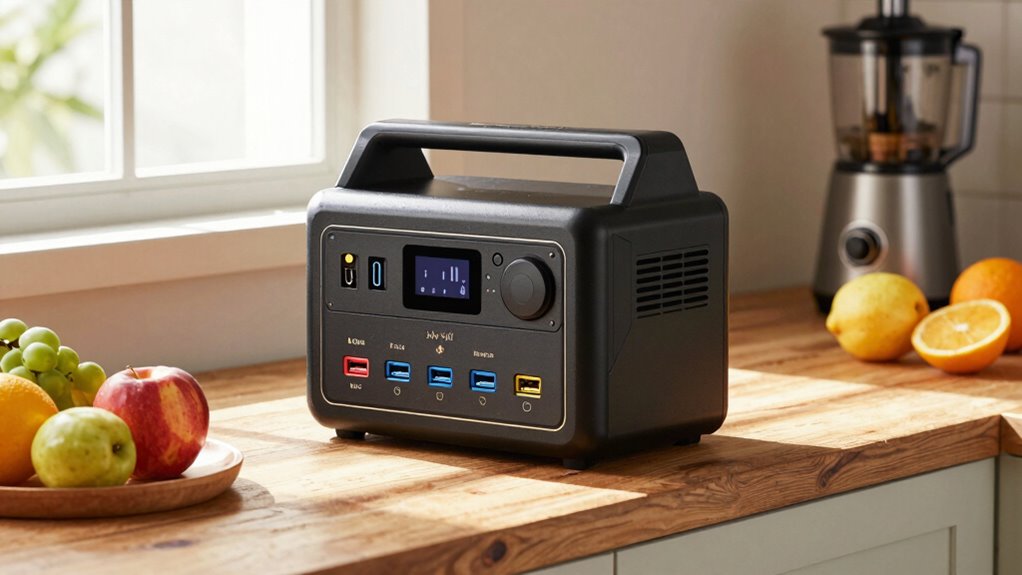

To guarantee your portable power station can handle juicers and blenders, you need to calculate their wattage needs. Check each device’s wattage rating and multiply by the hours you’ll use them to determine energy use in watt-hours. Add up these totals and compare them to your power station’s capacity, accounting for efficiency losses. Doing this helps prevent overloads and keeps your devices running smoothly; keep going to learn more tips for effectively using your setup.

Get kitchen staples and gadgets delivered free with Prime
- Fast, free delivery on millions of items
- Prime Video, Amazon Music and more included
- Member-only deals all year
Key Takeaways
- Calculate total watt-hours by multiplying each appliance’s wattage by its expected usage time.
- Ensure the power station’s capacity exceeds the combined watt-hours to prevent overload and ensure reliable operation.
- Account for efficiency losses (10-15%) to determine the actual energy required from the power station.
- Select a power station with sufficient capacity to meet both the immediate and future energy needs of your devices.
- Verify solar panel compatibility to efficiently recharge the power station without damaging it or reducing recharge speed.
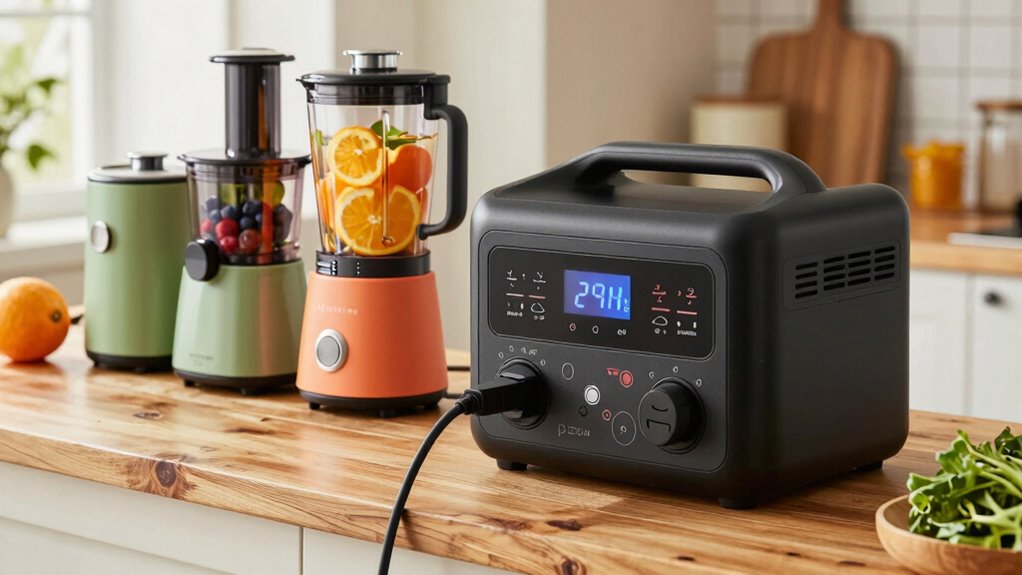
Are you looking for a reliable way to keep your devices powered on the go? Portable power stations are your best bet, especially when you want the convenience of charging or running appliances like juicers and blenders wherever you are. But to make sure your power station meets your needs, understanding wattage math is essential. First, you need to consider solar panel compatibility if you plan to recharge using sunlight. Not all solar panels work seamlessly with every power station, so checking the solar panel compatibility ensures you get efficient, safe, and reliable recharging options. Matching the solar panel’s voltage and wattage with the power station’s input specifications prevents damage and maximizes energy transfer. Once you’ve confirmed compatibility, the next critical step is battery capacity calculation. This process helps you determine how much energy your power station can store and, consequently, how long your devices can run before needing a recharge. Battery capacity is a key factor in ensuring your setup meets your power needs. To calculate the battery capacity, start by listing the power needs of your appliances. For example, if you want to run a blender that consumes 300 watts and a juicer that uses 150 watts, you need to account for their wattage and how long you plan to use them. Multiply the wattage of each device by the number of hours you expect to operate them, which gives you the total watt-hours required. Suppose you run the blender for 2 hours (300W x 2 = 600Wh) and the juicer for 1 hour (150W x 1 = 150Wh). Your total energy consumption would be 750Wh. Now, compare this with the power station’s battery capacity, which is usually measured in watt-hours (Wh). If your station has a 1000Wh capacity, you have enough juice to run your appliances comfortably, with some reserve for recharging or additional devices. Understanding these concepts helps you choose a portable power station that matches your energy demands and ensures your devices stay powered when you need them most. It’s also wise to factor in efficiency losses, which can occur during energy conversion, often reducing overall usable capacity by around 10-15%. This means you should aim for a slightly higher capacity than your calculated need to avoid running out of power unexpectedly. By paying attention to solar panel compatibility and performing accurate battery capacity calculation, you can optimize your portable power station setup, making it a dependable companion for outdoor adventures, emergencies, or remote work situations. The right combination guarantees you won’t be left in the dark or without power just when you need it most.
portable power station for blender and juicer
As an affiliate, we earn on qualifying purchases.
As an affiliate, we earn on qualifying purchases.
Frequently Asked Questions
Can Portable Power Stations Handle High-Wattage Blenders?
Yes, a portable power station can handle high-wattage blenders if its power output matches or exceeds the blender’s wattage requirements. You need to check device compatibility carefully. Make sure the station’s wattage rating supports the blender’s startup surge and continuous power needs. If you choose the right station with sufficient power output, you can confidently run high-wattage blenders on the go without issues.
How Long Can a Power Station Run a Juicer Continuously?
Like a marathon runner, your power station can only keep going for so long. Typically, it runs a juicer for about 30 minutes to an hour, depending on its battery life and the juicer’s wattage. Keep in mind, charging time matters—recharging your power station takes several hours, so plan your juicing marathon accordingly. Always monitor your station’s capacity to avoid unexpected shutdowns and maximize your juice session.
Are There Safety Concerns When Using Power Stations With Kitchen Appliances?
Yes, there are safety concerns when using power stations with kitchen appliances. You should always consider fire hazards and electrical safety. Make sure your power station matches the appliance’s wattage requirements and avoid overloading it. Keep the area clear of flammable materials, and never leave appliances unattended while in use. Following these precautions helps prevent fire hazards and guarantees safe operation of your kitchen appliances with portable power stations.
Do Portable Power Stations Require Special Outlets for Blenders?
Think of your portable power station as a versatile extension cord, but you still need the right outlet. Usually, it doesn’t require special outlets for blenders, as long as the power outlet requirements match its wattage and voltage. Check your power station’s specifications to guarantee outlet compatibility. If your blender has a high wattage, verify that your station can handle it safely, preventing overloads or damage.
How Does Battery Capacity Affect Juice and Smoothie Blending Sessions?
Your blender’s battery capacity directly impacts your blending sessions by determining how long you can operate it on a portable power station. A larger battery capacity offers longer battery life, so you can blend multiple smoothies or juices without recharging. Additionally, choosing an energy-efficient blender consumes less power, making your sessions more sustainable. Keep an eye on both battery capacity and energy efficiency to maximize your blending time and enjoy fresh drinks anytime.
Conclusion
So, now you see—understanding wattage isn’t just math; it’s the key to opening your portable power’s potential. By matching your juicer or blender’s wattage needs with the station’s capacity, you guarantee smooth operation every time. Don’t let confusion dim your adventure; instead, let knowledge be your guiding light. With the right wattage, your portable power station becomes not just a device, but a reliable partner on every journey. Power on and blend your way forward!
Halloween Picks
halloween
As an affiliate, we earn on qualifying purchases.