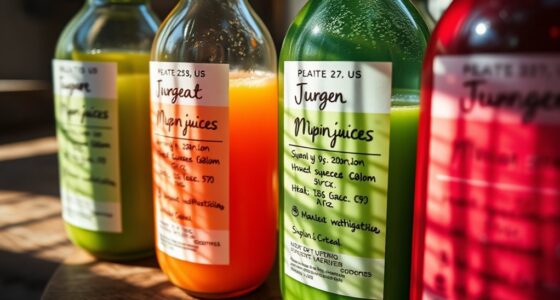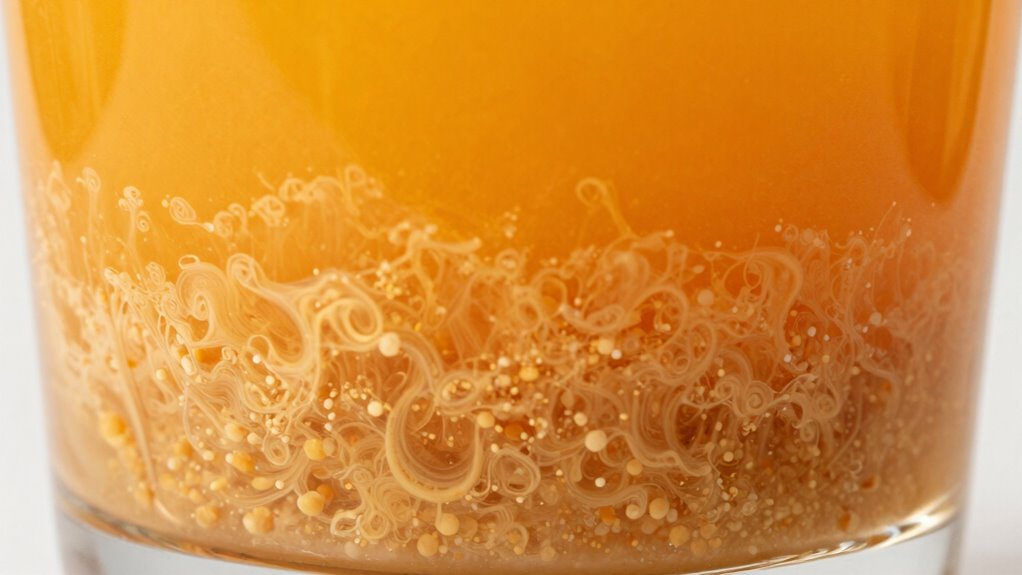
Juice sediment settles quickly because particles like pulp, cell debris, and microbial remnants naturally clump together and fall out due to gravity. Factors like fermentation, particle size, and composition influence this process, with larger or denser particles settling faster. Acidic conditions promote coagulation, speeding up sediment formation, while cooler storage slows it down. Understanding these factors helps explain why sediment appears rapidly—continue exploring to uncover more about what influences this process.
Key Takeaways
- Larger, denser particles naturally settle faster due to gravity, leading to quicker sediment formation.
- Fermentation promotes particle clumping and microbial activity, accelerating sedimentation.
- Acidic pH causes solids to coagulate into larger particles that settle more rapidly.
- Warmer temperatures increase microbial activity, speeding up particle aggregation and sedimentation.
- Processing and storage conditions influence particle stability and the rate at which they settle.
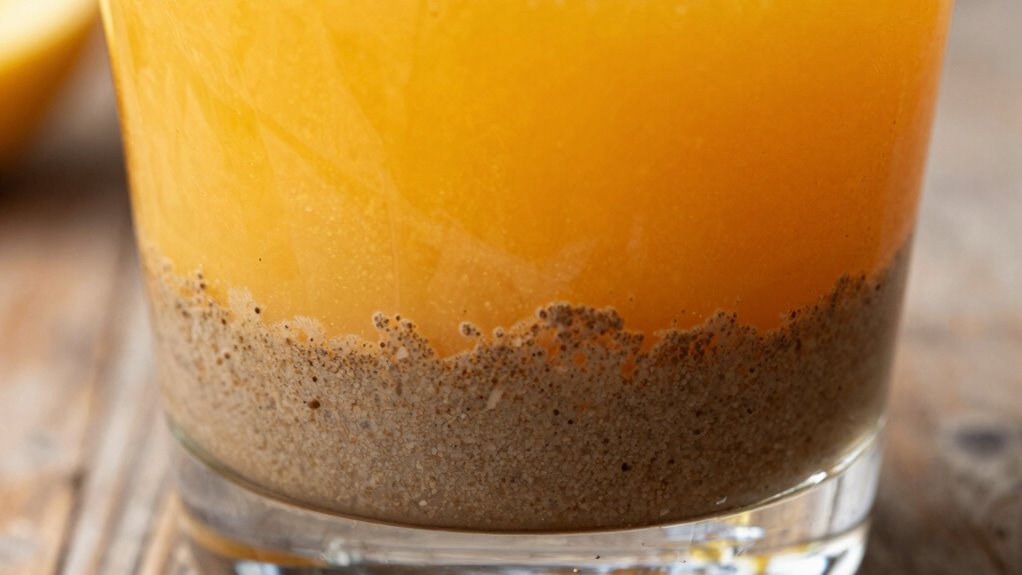
When you pour juice, you might notice a layer of sediment settling at the bottom. This phenomenon is more than just a visual quirk; it’s a result of underlying scientific processes, especially related to fermentation and pH levels. Understanding why sediment forms so quickly in some juices can help you better grasp the complexities behind what seems like simple liquid. At its core, sediment consists of particles that have separated from the juice’s liquid phase, often because of natural or induced changes during processing or storage.
Fermentation processes play a significant role in sediment formation. When fruit juices undergo fermentation, yeasts and bacteria convert sugars into alcohol and other byproducts. This activity can cause solids like fruit pulp, cell debris, or microbial remnants to clump together and settle out of the liquid. Even in non-fermented juices, trace amounts of these microorganisms or residual fruit solids can contribute to sediment. The speed at which sediment settles depends on the fermentation stage and whether the juice has been pasteurized or filtered. Less processed, less filtered juices tend to have more suspended particles, which settle faster when left undisturbed. Additionally, particle size influences how quickly the sediment settles, with larger particles falling faster due to gravity. The particle composition also affects the rate of sedimentation, as different materials have varying densities and affinities for settling. The particle stability over time can also be affected by chemical changes within the juice, impacting how particles aggregate or disperse. Moreover, storage conditions such as exposure to light or oxygen can influence the rate at which particles form and settle.
Fermentation causes solids to clump and settle, influenced by processing and filtration levels.
The pH level effects are equally important. Juices typically have a low pH, making them acidic. Acidic conditions influence both the stability of particles within the juice and the activity of microorganisms that can accelerate sedimentation. When the pH drops below a certain point, it can cause proteins and other suspended solids to coagulate, forming larger particles that settle more quickly. Conversely, if the pH is higher, particles remain more dispersed, keeping the juice clearer for longer. The acidity also affects fermentation: more acidic juices often inhibit microbial activity, reducing sediment formation, whereas less acidic juices might foster fermentation, leading to more sediment. Additionally, the microbial activity within the juice can vary depending on storage conditions, further influencing sedimentation rates. Temperature also interacts with fermentation and pH effects, speeding up or slowing down particle settling. Warmer temperatures generally accelerate fermentation processes, increasing sedimentation rates as microbes become more active. Cooler temperatures slow microbial activity, resulting in fewer particles forming and settling more slowly. Proper storage conditions and the initial juice quality also play a crucial role in sediment behavior over time.

KALAVE Premium Stainless Steel Funnel, 5 Inch Food Grade Kitchen Funnels with 200 Mesh Food Filter Strainer for Filling Bottles, Oils, Juice, Wine, Coffee, Milk
Food-Grade Funnel Set: Kalave metal funnel crafted from 100% food grade high-quality stainless steel, The detachable 200 mesh…
As an affiliate, we earn on qualifying purchases.
As an affiliate, we earn on qualifying purchases.
Frequently Asked Questions
Can Adding Pulp Prevent Sediment Formation in Juice?
Adding pulp can help prevent sediment formation by improving pulp consistency and ensuring even pulp distribution throughout your juice. When pulp is well mixed, it stays suspended longer, reducing sediment settling at the bottom. However, too much pulp might affect the juice’s texture, so find a balance that maintains smoothness while keeping pulp evenly dispersed. This way, you enjoy a fresher, more uniform juice experience.
Does Temperature Affect How Quickly Juice Sediment Settles?
Sure, temperature dramatically influences how quickly juice sediment settles. Warmer temperatures speed up settling dynamics, causing sediment composition to separate faster, while colder temps slow everything down, giving you more time to enjoy your beverage before it turns into a murky mess. So, if you want sediment to settle slowly, keep your juice chill. Otherwise, warm it up and watch your sediment quickly settle—like a dramatic soap opera finale.
Are There Specific Fruit Juices More Prone to Sediment?
Certain fruit juices, like apple, pear, and grape, are more prone to sediment due to their fruit composition, which includes higher levels of pulp and insoluble solids. These components naturally reduce juice clarity, making sediment more visible and settling faster. Juices from fruits with lower pulp content, such as citrus, tend to stay clearer longer. Your choice of fruit influences sediment formation and overall juice clarity.
How Does Storage Time Influence Sediment Accumulation?
As you store juice longer, sediment accumulation increases due to the ongoing settlement of particles in the sediment composition. Over extended storage durations, tannins, pectins, and other solids continue to settle, making the sediment more noticeable. So, if you keep juice for a while, expect more sediment to gather at the bottom. Regular shaking can help redistribute the sediment, but it won’t prevent its formation entirely over time.
Can Filtering Remove All Juice Sediment Effectively?
Filtering can notably reduce juice sediment, but it might not remove all particles completely. While it enhances flavor by creating a clearer, smoother drink, some nutrients could be lost during the process. If you want to preserve nutrients and boost flavor, use fine filters or multiple filtering steps. However, keep in mind that a little sediment might remain, so balancing clarity with nutrient retention is key for your ideal juice.

IOS Love Organic Juice – USDA Organic Certified – Cold Pressed, No Added Sugar, No Water, No Artificial Colors, No Preservatives, No Flavors Added, No Gluten – 33.8 Fl Oz (Watermelon, Pack of 6)
USDA Organic Certified – Organic Pomegranate Juice – Glass Bottle each
As an affiliate, we earn on qualifying purchases.
As an affiliate, we earn on qualifying purchases.
Conclusion
Now that you understand why juice sediment settles so quickly, you see it’s more than just a messy nuisance—it’s a dance of particles driven by gravity and density. Like a silent storyteller, the sediment reveals the juice’s true nature, whispering secrets of its composition. So next time you see it settle, remember: it’s not just settling, it’s settling into its own story, patiently revealing what lies beneath the surface.

Wine Making Kit Home Brewing – Complete Grape Juice Brew Starter Set for Beginners, 1 Gallon Glass Fermentation Jar with 4 Bottles, Yeast & Nutrients, Siphon, Airlock and Step-By-Step Guide
Complete Home Brewing Kit for Beginners: This wine making kit provides everything you need for wine making. No…
As an affiliate, we earn on qualifying purchases.
As an affiliate, we earn on qualifying purchases.

2 Pack pH Test Strips, 160 Strips pH.1-14 Universal pH Test Paper Litmus Test Paper Soap Making Testing Strips for Water Wine Saliva Urine Soil Testing Pet Food and Diet pH Monitoring (Sealed Pack)
【Highly Accurate and Quick Readout】- 2 Pack (160pcs) HomEnjoy pH test strips is made of high-quality filter paper,…
As an affiliate, we earn on qualifying purchases.
As an affiliate, we earn on qualifying purchases.