TL;DR

Get kitchen staples and gadgets delivered free — and shop member deals
- Fast, free delivery on millions of items
- Access to Prime Big Deal Days deals on October 6–7
- Prime Video, Amazon Music and more included
Building an AI workstation used to always be cheaper, but recent component shortages and price spikes have made prebuilt systems more competitive. The decision now hinges on control, support, and your specific workload—cost is just one factor.
Imagine you’re staring at a mountain of GPU cards, RAM sticks, and cooling fans. Building your own AI workstation sounds like a neat puzzle—customized, cheaper, full control. But what if a prebuilt system arrives with everything tested and ready to deploy—no fuss, no troubleshooting? The old rule was simple: build to save money, buy to save time. Not anymore. The market has shifted, and now the real question is: which option matches your workload, your skills, and your timeline? This article breaks down the tradeoffs so you can pick the right path for your AI projects.
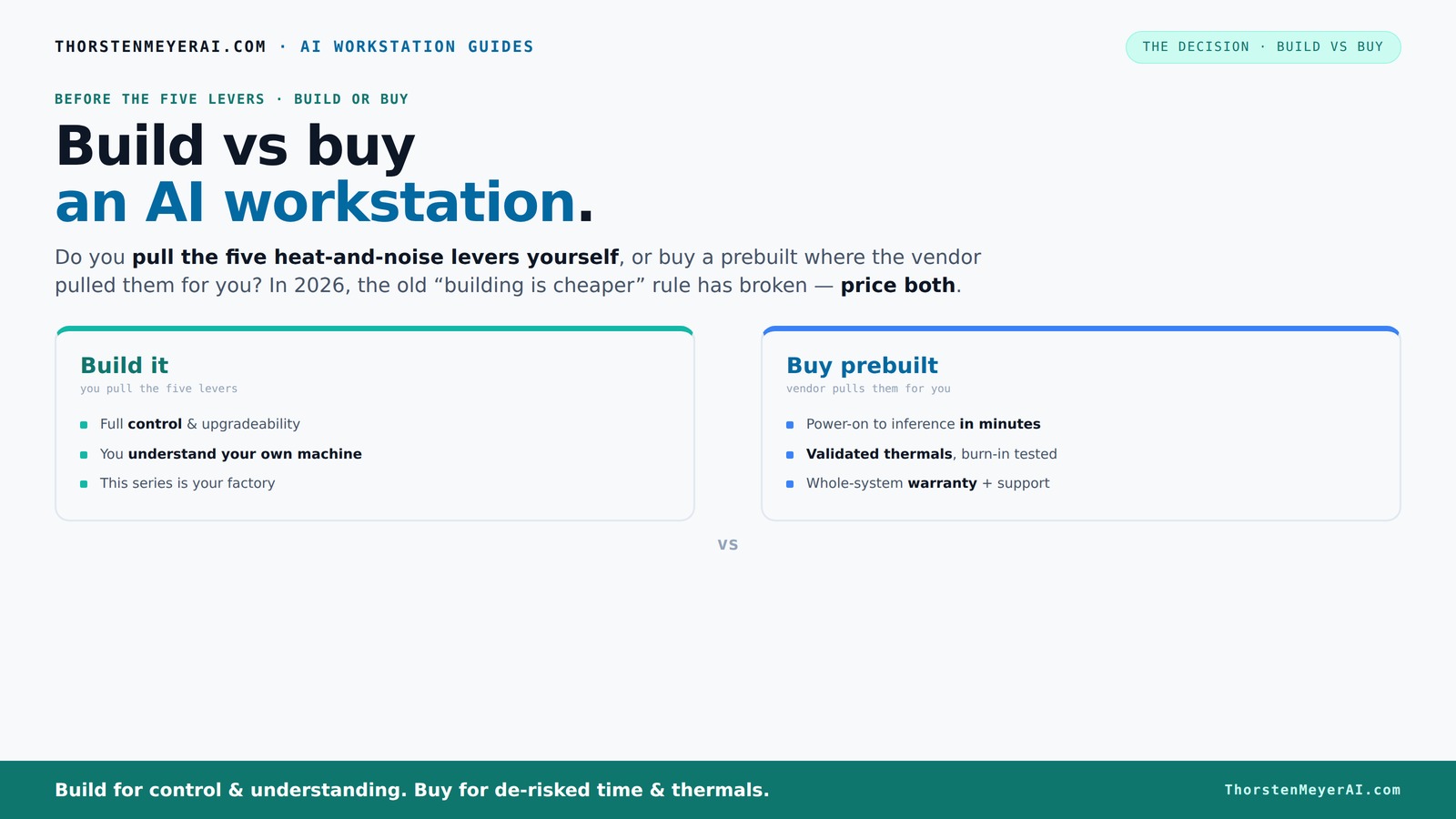
Build vs buy
an AI workstation.
The real question behind this whole series: do you pull the five heat-and-noise levers yourself, or buy a prebuilt where the vendor pulled them for you? And in 2026, the old “building is cheaper” rule has broken. Match your situation in Part 3.
Key Takeaways
- Component shortages in 2026 mean prebuilts can match or beat DIY on price for high-end AI systems.
- Prebuilt systems offer validated thermals, optimized cooling, and warranties—saving time and reducing risk.
- Building gives you full control over upgrades and customization, but requires technical skill and effort.
- Support and warranty are often overlooked but critical for avoiding costly downtime during AI training.
- Your workload, budget, and skills should guide whether you build or buy—there’s no one-size-fits-all answer.
high performance AI workstation prebuilt
As an affiliate, we earn on qualifying purchases.
As an affiliate, we earn on qualifying purchases.
What is an AI workstation and why does it matter?
An AI workstation isn’t just a powerful PC—it’s a specialized machine designed to handle huge models, massive datasets, and intense computations. Think of it as a high-performance engine built to keep cool under pressure, with the right mix of GPUs, fast memory, and reliable power. For AI developers, data scientists, or research teams, this machine is their daily workhorse. The right setup accelerates training, inference, and experimentation, making your work faster and more efficient.
Build vs buy: the short answer—what really changes in 2026?
Traditionally, building your own AI workstation was cheaper—assembly, parts, and DIY know-how meant savings. But in 2026, that’s no longer a given. Component shortages, inflation, and bulk discounts have pushed prices up for GPUs, RAM, and SSDs. You can learn more about building vs buying AI workstations. Meanwhile, prebuilt vendors now stock systems with validated thermals, optimized cooling, and warranties. The choice depends less on cost and more on control, support, and speed. Your decision hinges on whether you want to tinker or prefer a plug-and-play experience.
Cost comparison: building or buying—what’s the real picture?
Here's a quick breakdown. Building your own AI workstation used to cost around $1,200 for a decent setup. Today, that same build can easily hit $1,500 or more, thanks to GPU shortages and component inflation [1].
Prebuilts from top vendors like Lambda or Puget often price out similarly—sometimes cheaper—because they buy in bulk and optimize for efficiency. Check out build vs buy options. For example, a prebuilt with dual GPUs, 128GB RAM, and enterprise-grade cooling might cost $2,000, but includes validation, warranty, and support.
So, before you decide, actually compare prices for your specific config. Don’t assume DIY is cheaper anymore.
Performance and reliability: what difference does it make?
The biggest concern isn’t just raw specs—it's whether your machine can run 24/7 without throttling or crashing. Prebuilt systems undergo extensive testing, with validated thermals and optimized cooling. You can read more about prebuilt system reliability. Vendors like Lambda guarantee that their systems won’t throttle during long training runs [1].
If you build yourself, you’re responsible for tuning fans, selecting the right cooling, and ensuring compatibility. A poorly cooled GPU can drop performance by 20% or more during heavy workloads.
For example, a prebuilt workstation might run at 65°C under load, while a DIY setup with a cheap cooler could hit 80°C, risking thermal throttling and reduced lifespan.
Understanding this difference is crucial because thermal management directly impacts how long your hardware can operate at peak performance without risking damage or failure. For more details, see thermal considerations in AI workstations. Proper cooling not only sustains performance but also extends the lifespan of expensive components, saving money in the long run. Conversely, inadequate cooling might lead to frequent crashes, data loss, or costly replacements, which can derail your project timelines and inflate costs.
Upgradeability and longevity: can you keep up in 2026?
Building your own machine means you control future upgrades—more RAM, better GPU, newer CPU. But that also depends on the motherboard and power supply. Some prebuilts use proprietary parts, making upgrades tricky or costly.
In 2026, many OEM systems come with custom motherboards and connectors, limiting options for future upgrades. DIY allows you to swap out components as needed, extending the life of your investment.
Imagine upgrading a GPU from 24GB VRAM to 48GB in a custom build, versus trying to do that in a prebuilt with proprietary slots. The DIY path offers flexibility, but only if you plan ahead.
This flexibility is significant because AI workloads evolve rapidly. Learn more about upgrading and future-proofing AI systems. The ability to upgrade components means your system can stay relevant longer, providing better ROI. Conversely, prebuilt systems with limited upgrade paths might become obsolete sooner, requiring a full replacement sooner than expected. Careful planning and choosing parts that adhere to standard interfaces are essential if you want to maximize longevity.
Support, warranty, and downtime—what matters most?
When your AI system crashes during a critical training run, support matters. Prebuilt vendors often include warranties of 3–5 years, with on-site or quick remote support. They handle troubleshooting, BIOS updates, and thermal tuning.
If you build your own, you’re on your own—unless you buy separate warranties on each component or pay for dedicated support. That can mean hours of frustration, especially if you’re not a hardware expert.
For instance, Lambda offers a 3-year on-site support service, so you’re covered if something fails mid-job. That peace of mind can be worth the extra cost.
Having reliable support and warranty coverage isn’t just about convenience—it’s about minimizing costly downtime that can delay projects, lead to data loss, or require expensive emergency repairs. In high-stakes AI development, quick resolution times and expert assistance can save thousands of dollars in lost productivity and reputation. Choosing a vendor with robust support options can be a strategic decision that pays off when things go wrong.
Who should buy a prebuilt—and who should build?
If your time is limited and you want a system ready to run in minutes, a prebuilt is a no-brainer. For example, a researcher needing immediate access to a multi-GPU workstation will benefit from vendor validation and support.
On the other hand, if you’re a hobbyist, student, or someone who loves tinkering, building your own can be rewarding—and often cheaper if you already have some skills. You get exactly what you want, down to the cooling fans and power connectors.
Ultimately, your choice depends on your priorities: speed and ease versus customization and control. Understanding these tradeoffs helps you pick the approach that best aligns with your skills, budget, and project timelines.
Checklist before making your decision
- Define your workload—training, inference, or both?
- Set your budget, including future upgrades and support costs.
- Assess your technical skills or willingness to troubleshoot.
- Compare prices for your specific configuration—build vs buy.
- Consider the importance of thermal validation, noise levels, and warranty.
- Decide whether immediate deployment or customization matters more.
Frequently Asked Questions
Is it cheaper to build or buy a prebuilt AI workstation?
In 2026, component prices have risen, making prebuilts competitive or even cheaper than DIY setups for high-end systems. Always compare specific configurations before deciding.What performance difference should I expect?
Prebuilts often come with validated thermals and optimized cooling, resulting in more consistent performance during long AI training sessions. DIY can match this if you tune carefully, but it requires expertise.Which option is better for AI training vs inference?
For training, stability and cooling are critical—prebuilts excel here. For inference, flexibility and upgradeability might sway you toward building your own, especially if you need custom hardware or software stacks.Are prebuilts easier to upgrade later?
Generally, yes—prebuilts from reputable vendors include easy-access cases and standard parts. But beware of proprietary components that can limit future upgrades.When does building become worth the effort?
If you enjoy hardware tinkering, want full control, or have a tight budget, building often pays off—especially if you already have some skills or spare parts.Conclusion
Deciding to build or buy your AI workstation isn’t just about costs—it's about control, support, and how quickly you need to start. In 2026, the best choice depends on your specific needs and skills, not just the price tag.
Imagine a machine tuned perfectly to your workflow, humming quietly in the corner, or a ready-to-run system delivering instant results. The right answer is the one that aligns with your goals—and your patience for the process.
NFL season / tailgating Picks
team gear
As an affiliate, we earn on qualifying purchases.