
TL;DR

Get kitchen staples and gadgets delivered free — and shop member deals
- Fast, free delivery on millions of items
- Access to Prime Big Deal Days deals on October 6–7
- Prime Video, Amazon Music and more included
Electric citrus juicers use a motorized cone or press to extract juice from halved citrus with less hand effort than a manual reamer. Choose by the fruits you juice, pulp control, container size, cleanup, and storage space; advertised power alone does not tell you how much juice you will get.
Fresh orange juice can turn a quiet breakfast into a bright, citrus-scented start, but squeezing enough oranges by hand can leave your wrist tired. An electric citrus juicer does the turning for you, pressing juice from oranges, lemons, limes, and grapefruit with less hand effort.
This guide explains how the machines work, which features matter, and when a manual reamer may make more sense. You’ll be able to match a juicer to your fruit, batch size, cleanup habits, and available cupboard space.
Choose cone sizes that fit the lemons, limes, oranges, and grapefruit you actually juice.
Match container size and pour style to your normal batch, from one glass to a larger jug.
Check pulp control and removable parts if texture and quick cleanup matter to you.
A juicer’s advertised power does not predict yield on its own; fruit and design affect how much juice you extract.
Rinse parts soon after use, refrigerate leftover juice promptly in a covered container, and unplug before cleaning.
How an Electric Citrus Juicer Gets Juice Into Your Glass
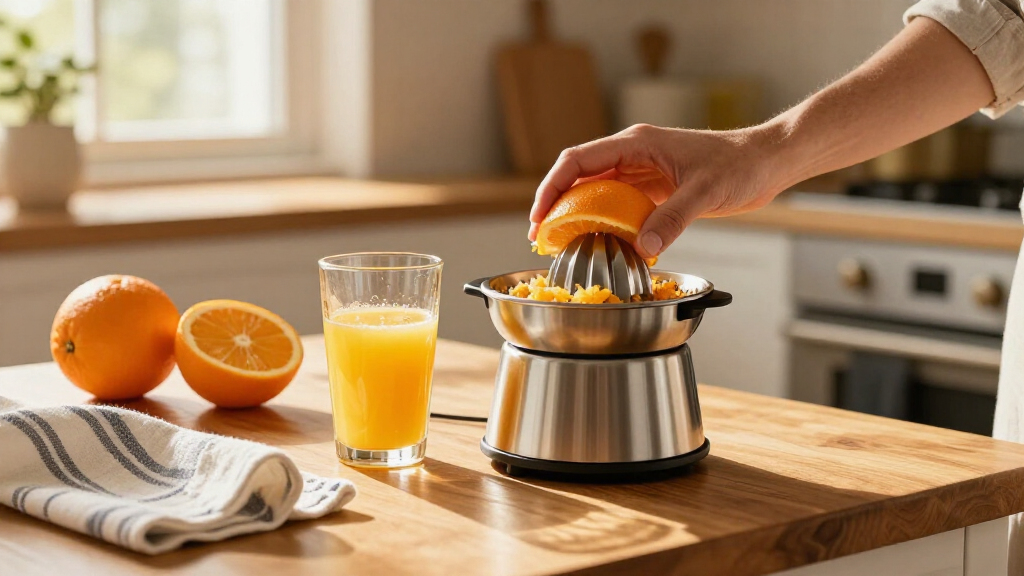
An electric citrus juicer extracts juice by pressing a halved fruit against a ridged cone that spins under motor power. The ridges break into the fruit’s segments as you apply light pressure, and juice passes through a strainer into a cup or container. Some designs use a lever to help press the fruit against a reamer. The basic mechanism is simple, but its fit to your routine matters: the cone has to contact enough of the fruit’s interior to extract juice without making each half awkward to hold or press.
For example, cut an orange across its middle, set one half cut-side down on the cone, and press gently. The cone turns with a low buzz, and the juice runs through the strainer; when the flow slows, lift the rind and repeat with the other half. That pause is useful: pressing harder may extract a little more, but too much pressure can push bitter compounds from the white pith into the juice. Keep your fingers clear of the moving parts.
Electric models reduce the work of turning a reamer by hand, which can help if you regularly squeeze several oranges or find twisting painful. The tradeoff is that you need to set up, clean, and store an appliance, even for a small amount. They do not remove every trace of bitterness or acidity: fruit variety, ripeness, and freshness shape the flavor too. A ripe, fragrant orange often tastes sweeter than an underripe one, whatever machine you use.
Match the Cone and Strainer to the Fruit You Juice
To juice several citrus sizes well, choose a model with cone sizes suited to your fruit and a strainer that handles your preferred pulp level. Small cones suit lemons and limes, while larger cones are more practical for oranges and grapefruit. A cone that is too large can make a small fruit harder to center; one that is too small may support a large half unevenly, so you may need to reposition it or press more carefully. Interchangeable cones can make one machine more adaptable, though they add a part to store and clean.
Think about a weeknight recipe: a small cone makes it easier to press a lime for tacos, while a large orange can wobble on a cone meant for tiny fruit. That wobble can interrupt the pressing motion and make the process less comfortable. If grapefruit is a regular part of breakfast, check the manufacturer’s guidance for fruit size instead of assuming every model will manage it; a fruit that does not fit securely may take longer to press and be harder to handle safely.
A strainer generally catches seeds and some pulp. Some juicers offer adjustable pulp control, while others give you little say over what reaches the glass. More open filtering tends to let pulp pass through, adding body but also making juice less uniform; finer filtering gives a smoother pour but can retain more pulp on the strainer, which may need rinsing sooner. If you like juice with a soft, cloudy texture, minimal filtering may suit you; if you want a smoother pour, look for a finer or adjustable strainer.
Compare Size, Capacity, Cleanup, and Juicing Style
Compare an electric citrus juicer by how you use it day to day: the fruit you press, how much juice you make, and how quickly you can clean the parts. They range from compact reamers for occasional use to larger machines for frequent or commercial use. A small footprint often means a smaller container, so you may need to empty it more often. Capacity affects the rhythm of juicing: a larger vessel can reduce interruptions for a batch, while a compact design takes less cupboard room and may be easier to bring out for one serving.
| Feature | Compact model | Larger or lever-assisted model |
|---|---|---|
| Best fit | Single servings, small kitchens | Frequent juicing or bigger batches |
| Workflow | Pour from a small container or spout | Often handles more juice before emptying |
| Storage | Easier to tuck into a cupboard | Needs more counter or cupboard room |
| Pressing effort | Usually light hand pressure on the fruit | A lever may help apply pressure |
Picture Saturday breakfast for four: a machine with a direct-pour spout may work nicely if you make a few glasses, while a larger pitcher can save interruptions when you press a whole bowl of oranges. A direct-pour setup is convenient when you serve immediately, but can be less useful if you want to refrigerate a larger batch. For a lone lemon squeezed now and then, that bigger body may occupy precious cupboard space for no real gain.
Check whether the reamer, strainer, and juice container detach for cleaning, and whether the maker lists them as dishwasher-safe. Removable parts let you rinse the surfaces that touch juice, but several small pieces can take longer to wash and keep track of. Juice and pulp dry onto ridged surfaces quickly; rinse those parts soon after pressing, before sticky fibers cling like wet paper to a sieve. If cleanup feels like a chore, you may use the machine less often, so easy rinsing can matter as much as capacity.
Choose a Juicer That Fits Your Real Routine
For frequent batches or tiring hand-squeezing, an electric juicer can make fresh juice easier to prepare; for occasional use, a manual reamer may be simpler. The right choice depends on your routine and kitchen, not on price alone. A faster motor or a higher advertised power figure does not prove that a machine will extract more juice: yield also depends on the fruit’s size and condition, how the cone contacts it, the pressure applied, and how much pulp the strainer holds back. A feature is useful when it solves a recurring inconvenience, not simply because it sounds more capable.
Try this quick buying process before you choose:
- Count your usual fruit. Decide whether you squeeze one lemon for a recipe, a couple of oranges for breakfast, or a large batch for guests. This helps you judge whether the time saved during pressing is likely to outweigh appliance setup and cleanup.
- Check fruit fit. Confirm that the included cone works with the smallest and largest citrus you use. A secure fit makes pressing steadier and reduces the need to reposition fruit.
- Inspect the pour and pulp setup. Choose a small cup, direct-pour spout, or larger pitcher to match your batch, and look for pulp control if you care about texture. Container size affects how often you stop to empty it; strainer design affects both the texture of the juice and the rinsing afterward.
- Plan cleanup and storage. Check detachable parts, cleaning instructions, machine stability, cord and cupboard space, and noise if you juice early. A machine that is easy to access and rinse is more likely to fit into a regular routine.
A compact reamer can be a sensible choice for occasional use to squeeze a lime into dinner, especially if you already have a drawer of kitchen tools and little counter room. If you make a jug of orange juice most weekends, a stable model with a larger container may save effort and repeat pours. In both cases, prioritize the jobs the machine will actually do; extra capacity or power adds little value if your usual task is one small serving.
Keep Fresh Juice Tasty and the Machine Safe
Fresh citrus juice tastes best soon after pressing, so serve it promptly or refrigerate leftovers in a covered container. Use clean equipment and follow the manufacturer’s storage and cleaning instructions. Prompt chilling slows the loss of fresh flavor, while a covered container limits exposure to air and other refrigerator odors. If you’re preparing juice ahead for breakfast, cover the pitcher and chill it as soon as you finish.
For safe operation, set the juicer on a stable surface, follow its instructions, and keep fingers away from moving parts. Unplug it before cleaning or clearing a jam. The motor can restart if a control is activated, so disconnecting power removes that risk while you handle the strainer or cone. For example, if a seed wedges beneath the strainer, switch off and unplug the machine before lifting out the removable parts to clear it.
Electric citrus juicers are specialized appliances built around citrus and a reamer; general-purpose juicers handle a wider range of produce through different mechanisms. Their different designs mean that a citrus model is convenient for halved citrus but is not a substitute for equipment designed to process other produce. Pick a citrus model when oranges, lemons, limes, or grapefruit are the job. If you want to process a mix of produce, check that a general-purpose juicer is designed for those ingredients.
Frequently Asked Questions
Are electric citrus juicers worth buying?
They can be worth buying if you juice often or find a manual reamer tiring. If you squeeze a lemon now and then, a simple manual tool may be easier to store and clean.
Can an electric citrus juicer handle lemons, limes, oranges, and grapefruit?
Many models handle several citrus fruits, but performance depends on cone size and design. Check whether the juicer includes cones suited to both small fruit and larger oranges or grapefruit.
Does an electric citrus juicer remove pulp and seeds?
A strainer usually catches seeds and some pulp. Some models let you adjust pulp levels, while others offer little control, so check the strainer design if texture matters to you.
How do you clean an electric citrus juicer?
Follow the manufacturer’s cleaning instructions and unplug the juicer first. Rinse the reamer and strainer soon after use to keep pulp from drying onto them, and check which removable parts are dishwasher-safe.
Can you store freshly squeezed citrus juice?
Yes. Put leftovers in a covered container and refrigerate them promptly; the juice usually tastes freshest soon after pressing. Clean the juicer promptly as well, before juice and pulp dry on the parts.
Conclusion
Choose an electric citrus juicer around your real routine: the fruit you press, the amount you make, and the cleanup you’ll tolerate. If your usual batch is one lemon, keep it simple; if oranges appear every weekend, make ease of pressing and pouring your priority.
Pick the machine that earns its cupboard space, then let the next glass smell like freshly cut citrus.
NFL season / tailgating Picks
team gear
As an affiliate, we earn on qualifying purchases.