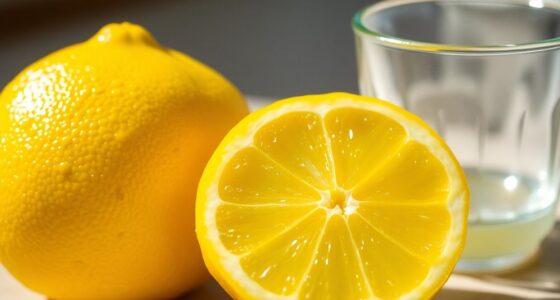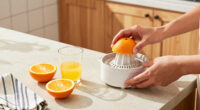
This guide shows you how to juice lemons, limes, oranges, and grapefruit with an electric citrus juicer so you get the maximum amount of juice with the least mess and effort. You will learn how to prepare the fruit, operate the juicer safely, control pulp levels, and clean the machine so it lasts for years.

Get kitchen staples and gadgets delivered free — and shop member deals
- Fast, free delivery on millions of items
- Access to Prime Big Deal Days deals on October 6–7
- Prime Video, Amazon Music and more included

Cuisinart Pulp Control Citrus Juicer, Black and Stainless Steel (CCJ-500P1)
- ✔ Model: CCJ-500P1
- ✔ Pulp settings: Low, medium, and high
- ✔ Juicing cone: Auto-reversing universal cone

BLACK+DECKER CJ625 Electric Citrus Juicer with Adjustable Pulp Control
- ✔ Brand: BLACK+DECKER
- ✔ Model: CJ625
- ✔ Capacity: 32 oz

Elite Gourmet ETS623 Electric Citrus Juicer, 24 oz, Black and Stainless Steel
- ✔ Motor power: 40W
- ✔ Capacity: 24 oz (3 cups)
- ✔ Operation: Push-down activation with auto-reversing reamer
This guide is written for beginners and anyone who has just purchased an electric citrus juicer or wants better results from the one they already own. It applies to both the common countertop reamer-style juicer (with a spinning cone you press fruit onto) and press-style electric models. The whole process takes about 10 to 20 minutes, and most of that time is cleanup.
Difficulty: Beginner | Time: 10-20 minutes (including cleanup)
What You’ll Need
Tools & Materials:
- An electric citrus juicer (reamer-style or press-style)
- Fresh citrus fruit (lemons, limes, oranges, or grapefruit)
- A sharp kitchen knife
- A cutting board
- A fine-mesh strainer (optional, for pulp control)
- Warm water and dish soap for cleaning
- A clean, dry towel
Knowledge:
- Basic kitchen safety around electrical appliances
- How to safely use a knife to halve fruit
Before your first use, check whether your model’s juicing cone, juice container, and pulp filter are dishwasher safe. Most are, but the motor base never is. If you no longer have the manual, the manufacturer’s website usually lists cleaning instructions by model number, which is often printed on the bottom of the base.
Buy slightly more fruit than you think you need. A medium lemon yields about 3 tablespoons of juice, a lime about 2 tablespoons, a medium orange about 1/3 cup, and a half grapefruit about 1/2 cup. Fruit that feels heavy for its size and has slightly soft, thin skin yields the most juice.
Cuisinart Pulp Control Citrus Juicer, Black and Stainless Steel (CCJ-500P1)
The Cuisinart CCJ-500P1 takes our top spot because it solves the two biggest complaints people have with electric citrus juicers: one-dimensional pulp texture and fruit-size limitations. Its three pulp settings — low, medium, and high — let you dial in exactly the texture you want, something neither the Elite Gourmet’s fixed filter nor the BLACK+DECKER’s simpler basket system matches in precision. If one person in your household likes pulpy orange juice and another prefers it strained, this is the model that keeps everyone happy.Compared with the BLACK+DECKER CJ625, the Cuisinart’s universal auto-reversing cone is a meaningful upgrade. Rather than swapping between small and large cones, one cone handles everything from key limes to grapefruits, which means fewer parts to keep track of and less fumbling mid-juice. The final-spin feature is another edge: the cone keeps spinning after you lift the fruit, extracting the last bits of juice that would otherwise end up in the compost.Practical details round it out well. The extra-long snap-up spout lifts out of the way to stop drips between pours — a small touch that keeps the counter clean — and the dishwasher-safe parts make daily cleanup painless. The limited 3-year warranty is the strongest coverage in this lineup, doubling the BLACK+DECKER’s one year and reflecting the stainless-accented build quality. The tradeoffs are modest but real: it occupies more counter space than the compact Elite Gourmet, and it’s priced accordingly. If you only juice the occasional lemon for a recipe, this level of capability is arguably more than you need.
Pros:
- Three adjustable pulp settings (low, medium, high) suit every preference
- Universal auto-reversing cone handles limes through grapefruits without swapping parts
- Final-spin feature extracts remaining juice after you lift the fruit
- Limited 3-year warranty is the longest in this lineup
Cons:
- Larger footprint than compact models like the Elite Gourmet ETS623
- Priced above simpler single-setting juicers
- Overkill for occasional lemon or lime juicing
Best for: Households that juice regularly and want precise pulp control across all citrus sizes, from limes to grapefruits
Not ideal for: Occasional juicers or those with very tight counter space who would be better served by a compact, cheaper model
Bottom line: The most complete citrus juicer of the three, with the best pulp flexibility, fruit range, and warranty for frequent juicers.
“The most complete citrus juicer of the three, with the best pulp flexibility, fruit range, and warranty for frequent juicers.”
BLACK+DECKER CJ625 Electric Citrus Juicer with Adjustable Pulp Control
The BLACK+DECKER CJ625 proves you don’t need to pay premium prices to get the features that matter most. It matches the Cuisinart on adjustable pulp control — the feature we consider the biggest differentiator in this category — and actually beats it on pitcher size, with a 32 oz container versus the Cuisinart’s smaller capacity. For families juicing a round of orange juice at breakfast, that extra volume means fewer trips to empty the pitcher.Where it differs from the Cuisinart is in the mechanism. Instead of a universal cone, the CJ625 uses two auto-reversing cones — small and large — that you swap depending on the fruit. It’s a minor inconvenience, but it also means each cone is purpose-shaped for its fruit size, and some juicers prefer that fit. The clear pitcher with measurement markings is genuinely useful for recipes, letting you juice directly to the exact amount a marinade or cocktail calls for without dirtying a measuring cup.Compared with the Elite Gourmet ETS623, the BLACK+DECKER trades compactness for capacity and versatility — the Elite Gourmet is easier to stash in a cabinet, while the CJ625 is built to handle bigger batches. Its main weakness is durability: the plastic container can scratch and cloud over time in ways glass or stainless components would not, and the one-year warranty is the shortest in this group. Still, if you want pulp control and family-size capacity without the premium price, this pick makes the most sense.
Pros:
- Adjustable pulp control with a removable pulp basket
- Largest pitcher in this lineup at 32 oz with measurement markings
- Small and large auto-reversing cones fit different citrus fruits
- Drip-free pour spout and clear pitcher simplify serving
Cons:
- Plastic container is less durable than glass or stainless alternatives
- Swapping cones between fruit sizes adds a small step the Cuisinart avoids
- One-year warranty is the shortest of the three
Best for: Budget-conscious families who want adjustable pulp control and a large 32 oz pitcher for batch juicing
Not ideal for: Buyers who prioritize long-term durability or a compact storage footprint
Bottom line: The smart budget choice, matching premium pulp control and beating rivals on capacity while sacrificing some build refinement.
“The smart budget choice, matching premium pulp control and beating rivals on capacity while sacrificing some build refinement.”
Elite Gourmet ETS623 Electric Citrus Juicer, 24 oz, Black and Stainless Steel
The Elite Gourmet ETS623 is the pick for kitchens where counter and cabinet space come at a premium. Its compact footprint and modest 24 oz container make it easy to store in a cabinet between uses, and its black-and-stainless finish looks more expensive than its class usually allows. If the Cuisinart is the full-size workhorse and the BLACK+DECKER the family batch-maker, this is the tidy little machine that lives next to the coffee maker.Don’t let the size fool you on power. Its 40W motor is stronger than the 25W motors typical of budget citrus juicers, which translates to steadier extraction through tougher grapefruit halves rather than a reamer that bogs down under pressure. The auto-reversing reamer works the same way as the cones on the other two models, spinning both directions to pull juice efficiently from oranges, lemons, limes, and grapefruit.The tradeoffs are structural rather than functional. There’s no adjustable pulp control — the integrated pulp and seed filter gives you one texture, which is a real limitation if your household is divided on pulp. Capacity is also the smallest here at 24 oz, so bigger batches mean juicing in rounds. Cleanup is solid, with top-rack dishwasher-safe removable parts, though hand washing is recommended to extend the product’s life — a common caveat for plastic juicing components. This model is better suited to individuals and couples who juice for one or two glasses at a time, not families serving four.
Pros:
- 40W motor is stronger than typical 25W budget models
- Auto-reversing reamer extracts juice in both directions
- Compact footprint stores easily in small kitchens
- Removable parts are top-rack dishwasher safe with an integrated pulp and seed filter
Cons:
- No adjustable pulp control — single fixed texture
- 24 oz capacity is the smallest in this lineup
- Hand washing recommended to maximize product life
- Citrus-only design won’t help with other produce
Best for: Individuals, couples, and small kitchens that juice in small batches and value compact storage
Not ideal for: Pulp-sensitive households or anyone juicing large batches for a family
Bottom line: The best small-kitchen option, trading capacity and pulp flexibility for space savings and above-average motor power.
“The best small-kitchen option, trading capacity and pulp flexibility for space savings and above-average motor power.”
As an Amazon Associate we earn from qualifying purchases.
Before You Start
Safety first: Never immerse the motor base in water or hold it under a running tap. Only the detachable parts get washed. Always unplug the juicer before removing parts or cleaning.
Warm your fruit for better yield. Roll the whole fruit firmly on the counter with your palm for 10 to 15 seconds before cutting, or microwave it for 10 to 15 seconds. Both methods break down internal membranes and can increase juice yield noticeably. Skip the microwave step if the fruit is already soft.
Set up your workspace: Place the juicer on a flat, dry surface near an outlet, with the drip-free spout (if your model has one) positioned over a glass or pitcher. Put a damp paper towel under the base if your counter is slick, so the machine does not slide while you press fruit.
Step-by-Step Instructions
Step 1: Wash and assemble the juicer
Wash the juicing cone, pulp filter, and juice container with warm soapy water if this is the first use, then rinse and dry them. Slide the pulp filter into place over the juice container, attach the juicing cone to the drive shaft, and set the container onto the motor base. Rotate each part until it clicks or seats firmly.
Tip: Most models will not start unless parts are seated in the correct position. If the cone does not spin later, re-seat it first before assuming the motor is faulty.
Check: All parts sit snugly with no wobble, and the spout (if present) points where you want juice to flow.
Step 2: Cut the fruit in half crosswise
Place the fruit on a cutting board and slice it in half through its equator — perpendicular to the segment lines running stem to stem. Cut cleanly through the center so each half shows a full circle of segments. Do not cut along the length of the fruit, because the reamer cannot reach the juice properly in lengthwise halves.
Tip: For grapefruit, cut each half in half again if your cone is small. Smaller pieces press more evenly.
Check: Each half shows a flat, round face with visible segments radiating from the center.
Step 3: Position the fruit on the cone
Place one fruit half cut-side down onto the juicing cone, centering the cone point in the middle of the fruit. Hold the fruit half by its rind with a firm, even grip. Keep your free hand on the fruit only — never near the base of the cone where the spinning edge sits.
Tip: If your model came with a fruit dome or pressing lid, use it instead of your hand. It protects your palm and presses more evenly.
Check: The fruit sits level on the cone with the cut face fully covering the reamer ridges.
Step 4: Press and juice the fruit
Press the fruit down onto the cone to activate the motor (most models start automatically from downward pressure; some have a switch). Apply steady, moderate pressure and let the cone spin. Lightly rotate the fruit a quarter turn every few seconds, then press again, so the reamer reaches all segments. Continue for 10 to 20 seconds per half, until the pulp filter collects dry-looking pulp and juice stops flowing into the container.
Tip: Let the machine do the work. Pressing hard enough to stall the motor strains it and does not extract more juice.
Check: The remaining rind looks pale and flattened, and juice has stopped dripping from the spout or filter.
Step 5: Repeat with remaining fruit and strain if desired
Lift the spent rind off the cone, set it aside, and repeat the pressing process with each remaining half. If you want less pulp, pour the collected juice through a fine-mesh strainer into your final glass, pitcher, or measuring cup. Press the pulp in the filter gently with a spoon to push through any remaining juice.
Tip: If your model has a pulp-control lever or adjustable filter, set it before you start juicing rather than straining afterward.
Check: You have the amount of juice your recipe needs, at the pulp level you want.
Step 6: Use the juice or store it properly
Pour the juice into your recipe, or transfer it to a sealed container. Fresh citrus juice keeps 2 to 3 days refrigerated. For longer storage, freeze it in ice cube trays, then move the frozen cubes to a freezer bag for up to 6 months — each standard cube is about 1 tablespoon, which makes future measuring easy.
Tip: Freeze lemon and lime cubes now to have measured portions ready for cooking and drinks later.
Check: Juice is used immediately or sealed in a container, not left open on the counter.
Step 7: Unplug and disassemble the juicer
Unplug the juicer from the outlet before cleaning. Lift the juice container off the base, remove the pulp filter, and pull the juicing cone straight up off the drive shaft. Scrape pulp out of the filter into the trash or compost — do not rinse large pulp loads down the drain, where they can build up and clog pipes.
Tip: Rinse parts immediately after juicing. Dried pulp sticks hard and takes three times longer to clean later.
Check: The motor base is unplugged and all detachable parts are separated and free of pulp.
Step 8: Wash the parts and wipe the base
Wash the cone, filter, and container in warm soapy water with a sponge or brush, paying attention to the grooves in the cone where pulp collects. Rinse thoroughly and dry, or place dishwasher-safe parts on the top rack. Wipe the motor base only with a damp cloth, then dry it. Store all parts completely dry, either reassembled or nested together, to prevent odors.
Tip: Use an old toothbrush on the reamer grooves and filter mesh — a sponge cannot reach into them well.
Check: All parts are clean, dry, and odor-free, and the base shows no juice residue or drips.
Common Mistakes to Avoid
- Cutting the fruit lengthwise instead of crosswise — Always cut through the fruit’s equator, across the segment lines, so the reamer can reach all the juice pockets. Lengthwise halves spin unevenly and yield far less juice.
- Pressing so hard the motor stalls or strains — Use steady, moderate pressure and rotate the fruit instead. If the cone slows or stops, ease up. Forcing it burns out motors on lower-wattage models.
- Juicing cold, hard fruit straight from the refrigerator — Roll the fruit on the counter under your palm or microwave it for 10 to 15 seconds first. Cold fruit is firm fruit, and firm fruit releases less juice.
- Putting the motor base in the sink or dishwasher — Only detachable parts touch water. Wipe the base with a damp cloth only, and always unplug it first.
Troubleshooting
Problem: The cone does not spin when fruit is pressed down
Solution: Unplug the unit, then check that the cone and container are fully seated — most models have a safety interlock that prevents operation when parts are misaligned. Re-seat each part until it clicks, then plug back in and try again.
Problem: Juice leaks from where the container meets the base
Solution: The spout is likely open or the filter is not seated. Close the spout lever when you pause between fruits, and check that the pulp filter is locked into the container. Some leak also occurs when you overfill; empty the container once juice nears the top.
Problem: Juice yield seems low
Solution: Warm and roll the fruit before cutting, make sure the cut is through the exact center, rotate the fruit a quarter turn several times during pressing, and press gently for a few extra seconds. Fruit that is old, lightweight, or thick-skinned simply yields less — buy heavy fruit with thin, slightly soft skin.
Problem: The juicer smells like burnt plastic or the motor feels hot
Solution: Stop immediately and unplug it. Let the motor cool for 15 to 20 minutes, then test again with light pressure for a single fruit. If the smell returns, stop using the appliance and contact the manufacturer — continuing to run an overheating motor creates a fire risk.
What Success Looks Like
You have completed the task correctly when: (1) each pressed rind comes off the cone pale, flattened, and nearly dry; (2) you have collected the expected volume of juice — roughly 3 tablespoons per lemon, 1/3 cup per orange, and 1/2 cup per grapefruit half; (3) the juice has your preferred pulp level; (4) the motor never stalled or overheated; and (5) every detachable part is washed, dried, and stored, with the base wiped clean and unplugged. If you achieved these, you extracted the maximum practical juice from your fruit and left the machine ready for its next use.
Next Steps
Once you are comfortable with the basic process, try these follow-ups:
- Freeze lemon and lime juice in ice cube trays today so you always have measured portions for recipes, marinades, and drinks.
- Test pulp settings or the adjustable filter with different fruit so you know your preferred configuration for juice versus cocktails.
- Add a weekly rinse of the filter mesh with a vinegar solution if you juice often — it removes mineral and pulp buildup a sponge misses.
- Descale and inspect the cone and filter monthly for cracks; a cracked cone reduces yield and can shed plastic into juice.
- If yield stays poor across multiple batches of fruit despite warm, heavy fruit and correct technique, compare results with a simple handheld reamer — a persistent gap may mean the motor or cone on your unit is worn and it is time for a replacement.
Frequently Asked Questions
Do I need to peel the citrus before juicing?
No. Cut the fruit in half and press the cut side onto the cone — the peel stays in your hand as the rind when juicing finishes. Peeling is only needed if you are using a centrifugal juicer designed for whole fruits, which is a different type of machine.
Can I juice other fruits or vegetables in an electric citrus juicer?
No. Citrus juicers are built specifically for halved citrus. Their cones and filters cannot handle apples, carrots, or soft berries. For those, you need a centrifugal or masticating juicer. Attempting non-citrus fruit in a citrus juicer produces poor results and can damage the cone.
How much pulp ends up in the juice, and can I control it?
Most juice flows through the pulp filter, so some fine pulp is normal. Models with adjustable pulp settings let you choose the level before juicing. On any model, pouring the finished juice through a fine-mesh strainer removes nearly all pulp if you prefer it smooth.
Are the removable parts dishwasher safe?
On most modern models, yes — the cone, filter, and container typically go on the top rack. The motor base is never dishwasher safe and should only be wiped with a damp cloth. Check your manual or the manufacturer’s website to confirm for your specific model.
Should I juice fruit at room temperature or cold?
Room temperature fruit yields noticeably more juice. If your fruit is refrigerated, let it sit out for 30 minutes, roll it firmly under your palm, or microwave it for 10 to 15 seconds before cutting. Once juiced, chill or use the juice however your recipe requires.
NFL season / tailgating Picks
team gear
As an affiliate, we earn on qualifying purchases.