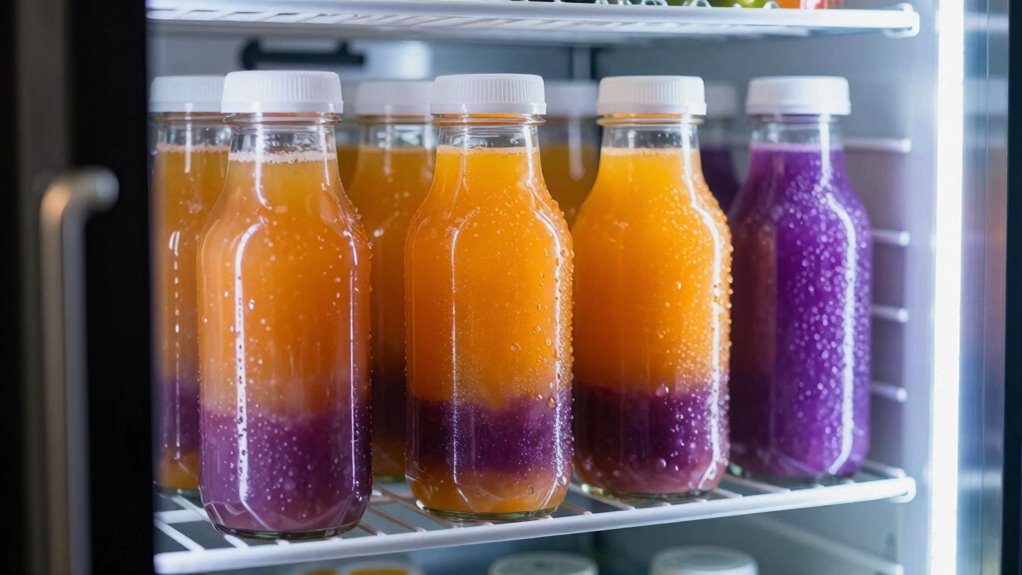

If your juices separate faster in refrigerated dispensers, it’s often due to their natural ingredients, like pulp or seeds, which settle over time. Juices that aren’t homogenized tend to separate more quickly, especially if they contain unprocessed fruit elements. Poor maintenance or temperature fluctuations can also speed up the process. To keep quality longer, it’s helpful to understand how ingredients and handling affect separation, and you’ll find useful details if you keep exploring further.

Get kitchen staples and gadgets delivered free with Prime
- Fast, free delivery on millions of items
- Prime Video, Amazon Music and more included
- Member-only deals all year
Key Takeaways
- Juices with high pulp or unhomogenized ingredients tend to separate faster in dispensers.
- Natural pulp and seeds settle over time, especially if not stabilized through homogenization.
- Improper cleaning and maintenance can cause uneven temperature distribution, accelerating separation.
- Incorrect temperature settings or fluctuations can weaken emulsion stability, leading to quicker separation.
- Extended storage or sitting time in dispensers increases the likelihood of juice separation.
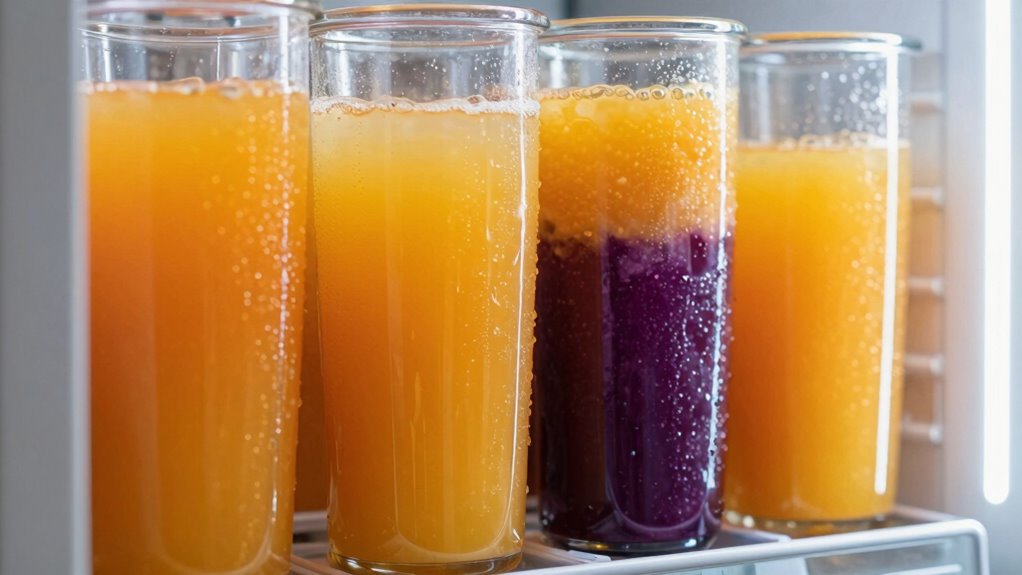
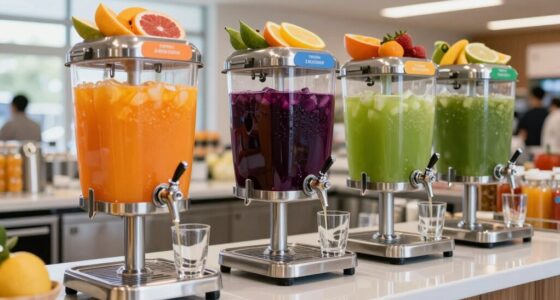
Have you ever wondered how businesses efficiently serve chilled beverages or perishable products? If you’ve ever used a refrigerated dispenser, you probably noticed that sometimes certain juices seem to separate faster than others. It’s a common issue, and understanding why it happens can help you maintain the dispenser better and improve the quality of what you serve. When you fill a dispenser with different juice flavors, you might see a layer of pulp or sediment settling at the bottom over time, especially if the mix contains natural fruit pulp or is unhomogenized. This separation isn’t just a visual concern; it can affect the taste and texture, making your drinks less appealing to customers or guests. The main reason some juices separate faster inside refrigerated dispensers is due to the composition of the juice itself. Juices with high pulp content or those that haven’t been processed to stabilize their emulsion tend to separate more quickly under cold storage. Natural fruit flavors and ingredients like pulp or seeds can settle out, especially if the juice isn’t homogenized. As a result, you may notice a change in flavor or consistency, which can be off-putting if not addressed promptly. To minimize this, you need to pay attention to the juice flavor and choose products that are designed for longer shelf stability or are properly homogenized. Proper dispenser maintenance plays a crucial role in preventing unnecessary separation. Regularly cleaning the dispenser ensures that residues, mold, or bacteria don’t interfere with the liquid’s consistency. Old or dirty parts can cause uneven temperature distribution, which accelerates separation. Additionally, ensuring the dispenser’s temperature is set correctly helps maintain the intended texture and prevents the juice from overheating or freezing, both of which can cause unwanted separation. Also, be cautious about how long you keep juices in the dispenser; over time, even the best-maintained units can contribute to separation if the juice is left sitting for too long. Proper handling and storage can also reduce separation and help preserve the quality of your beverages. Maintaining consistent temperature control is essential for preventing premature separation and ensuring the freshness of the juices. Regular monitoring of dispensing equipment can help identify issues early and prevent quality decline. Understanding the composition of juices and how it interacts with refrigeration can further aid in selecting the best products for your dispenser.
juice dispenser with homogenization technology
As an affiliate, we earn on qualifying purchases.
As an affiliate, we earn on qualifying purchases.
Frequently Asked Questions
Do Different Juice Types Separate at Different Rates?
Yes, different juice types separate at different rates. You’ll notice that juices with higher pulp or fiber content, like orange or apple juice, tend to separate faster, affecting flavor consistency. This separation can also impact nutrient preservation, as nutrients might settle or degrade unevenly over time. To keep your juice tasting fresh and nutrient-rich, give it a good stir before serving, especially if it sits in the dispenser for a while.
How Does Temperature Affect Juice Separation in Dispensers?
Imagine you’re pouring orange juice from a dispenser on a hot day. Higher temperatures cause juices to separate faster because increased heat disrupts the emulsion of pulp and liquid. Maintaining temperature stability and using container insulation helps prevent this separation. When the juice stays cool and the dispenser is well-insulated, the mixture remains uniform longer, reducing separation and keeping your drink smooth and consistent.
Can Adding Preservatives Reduce Juice Separation?
Adding preservatives can improve juice stability and potentially slow separation, but their effectiveness varies. Preservatives inhibit microbial growth, which can help maintain a uniform texture over time. However, they don’t eliminate all separation causes, especially if the juice’s natural composition promotes settling. To achieve ideal results, combine preservatives with proper storage and handling. This way, you enhance juice stability, but don’t rely solely on preservatives to prevent separation entirely.
Does the Dispenser’s Material Influence Juice Separation?
Think of the dispenser’s material as the armor protecting your juice. A plastic container may allow easier heat transfer, causing faster separation, while glass insulates better, slowing it down. The material influences how the dispensing mechanism works by affecting temperature stability. So, choosing a container with good insulation helps keep juices blended longer, ensuring each pour is just as fresh and uniform as you want it.
How Often Should Refrigerated Dispensers Be Cleaned to Prevent Separation?
You should clean your refrigerated dispenser at least once a week to maintain flavor consistency and guarantee proper dispensing speed. Regular cleaning prevents residue buildup that can cause juice separation and affect taste. If you notice separation or changes in flavor, increase cleaning frequency. Consistent maintenance keeps your dispenser functioning smoothly, preserves the quality of the juice, and ensures customers receive a fresh, uniform product every time they dispense.
Conclusion
So, next time your juice separates faster in a refrigerated dispenser, don’t assume it’s a flaw. It’s actually a natural process caused by temperature and ingredients. If it bothers you, just give the dispenser a gentle shake or stir—most separation is easily reversible. Remember, it’s a sign that your juice is fresh and natural. With a little patience, you can enjoy your beverage without worrying about separation, knowing it’s perfectly normal.
Halloween Picks
halloween
As an affiliate, we earn on qualifying purchases.